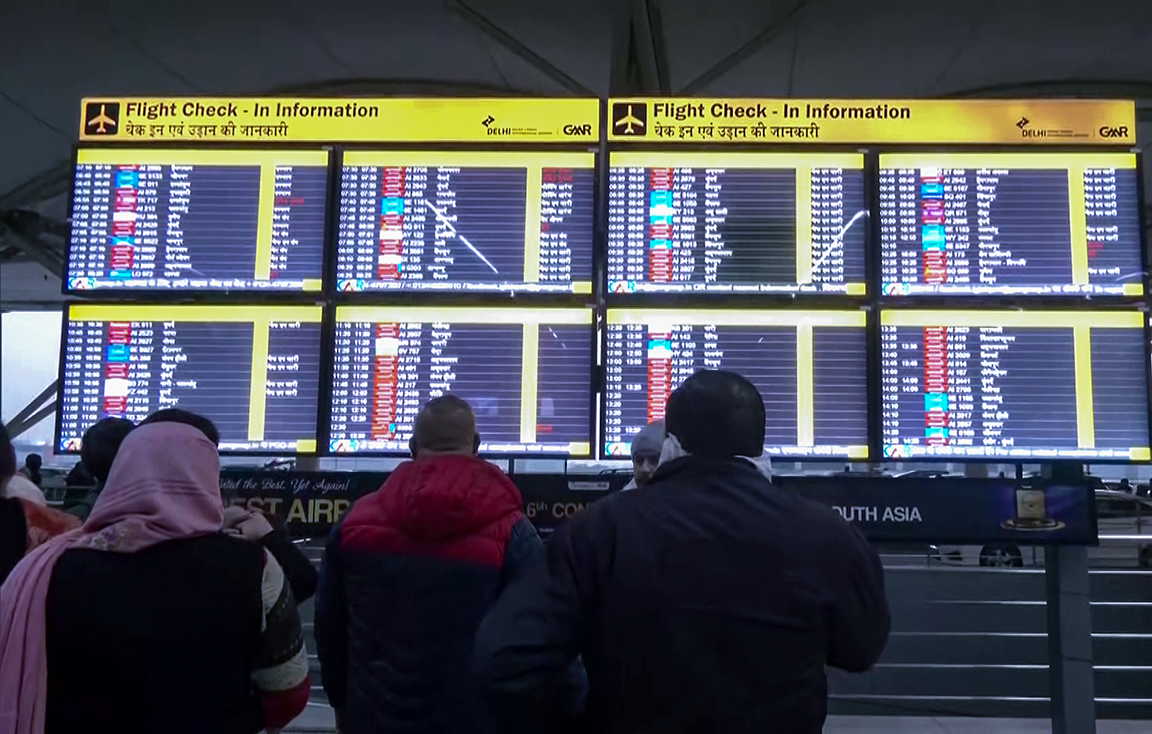
Severe weather conditions brought flight operations at Indira Gandhi International Airport to a near standstill overnight, with thunderstorms, rain and strong winds forcing multiple diversions and missed landings. Airport officials confirmed that at least 29 flights had to be diverted as conditions deteriorated rapidly across the capital.
The disruption began late on May 3, when an aerodrome warning flagged gusty winds and thunderstorms in the region. As weather intensity increased, the airport’s operational capacity was reduced, affecting both arrivals and departures and triggering a chain reaction of delays.
Wind shear and missed approaches
According to The Hindustan Times, the situation worsened around 10.30 pm, when heavy weather prompted a shift in runway operations. Pilots attempting to land faced significant challenges due to wind shear, a sudden change in wind speed or direction that can be particularly hazardous during descent.
Officials reported multiple missed approaches from both active runways within a short span. Several aircraft were forced to abort landings and circle back, adding to congestion in the airspace. Within minutes, the number of such instances climbed into double digits, reflecting the severity of conditions.
As the night progressed, the airport briefly switched operational modes in an attempt to manage the situation. However, strong winds continued to disrupt flight paths, making normal operations difficult.
Diversions and cascading delays
Between late evening and early morning, 29 flights were diverted to nearby cities, including both domestic and international services. While some aircraft managed to return and land in Delhi after conditions improved, others remained stationed at alternate airports for several hours.
Air traffic flow management measures were introduced to regulate incoming flights and ease congestion. These controls remained in place until shortly after midnight, when priority was given to aircraft attempting to return to Delhi.
The ripple effect was visible across the network. According to flight tracking data, hundreds of flights experienced delays, with departures continuing to run behind schedule even in the morning hours.
Also Read | Delhi clears massive Metro expansion with 97 km network push across new corridors
Gradual recovery after a turbulent night
Weather conditions began to stabilise in the early hours, allowing operations to slowly return to normal. By morning, the airport had resumed its standard mode of functioning, though residual delays persisted.
The episode highlights how vulnerable air travel remains to sudden weather changes, particularly during periods of intense seasonal activity. Even with advanced forecasting and air traffic management systems, conditions like wind shear can disrupt operations within minutes.
For passengers, the impact extended beyond the night, with many facing rescheduled departures and extended wait times. For airport authorities, it was a reminder of the need for constant coordination to manage such high-pressure situations efficiently.