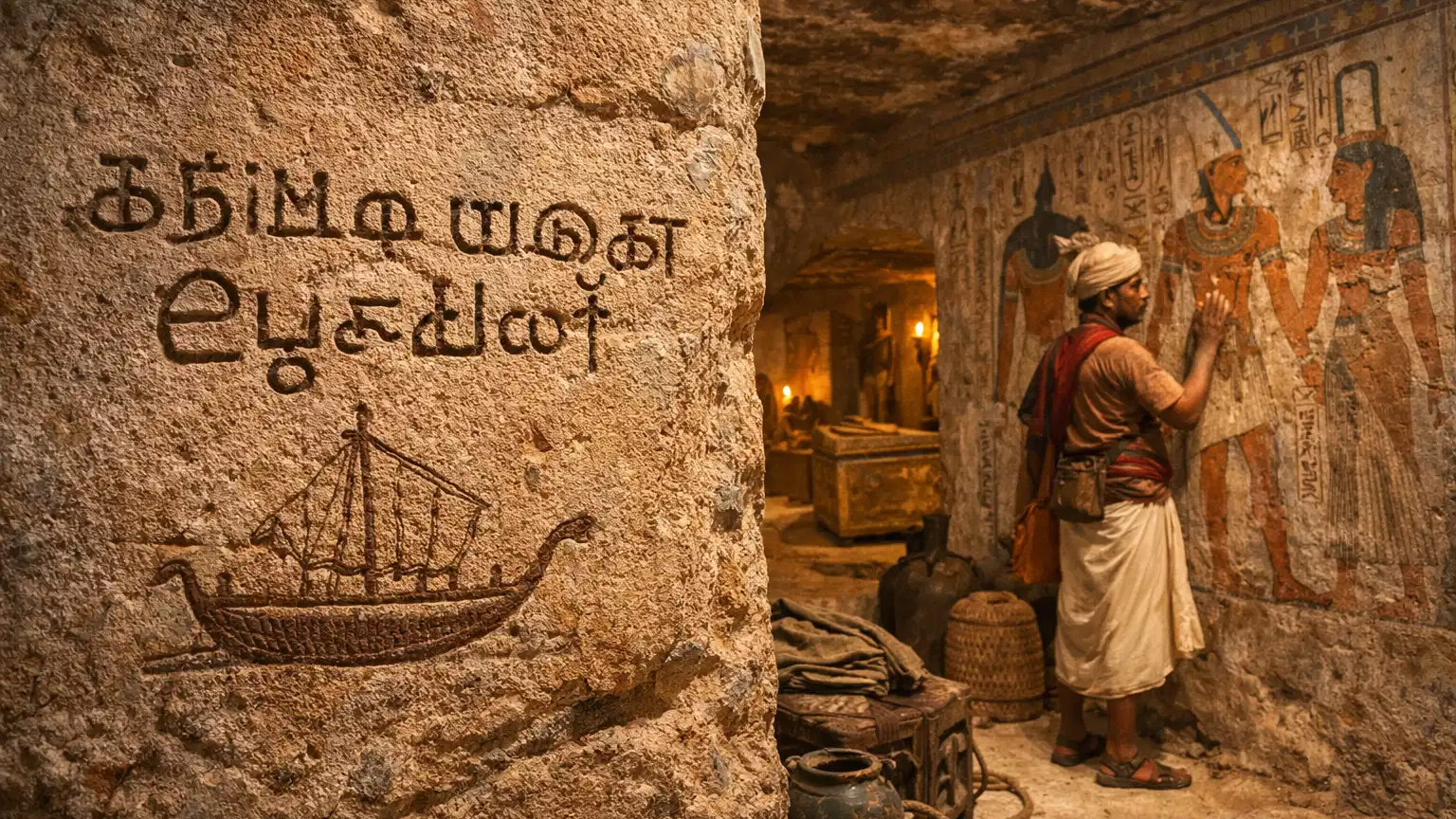
A set of nearly 2,000-year-old Tamil inscriptions discovered deep inside Egypt’s Valley of the Kings is reshaping what historians know about ancient global trade and travel. The carvings, written in Tamil-Brahmi script, suggest that Tamil merchants not only traded with Egypt during the Roman period but also journeyed far beyond port cities into the heart of the civilisation.
The inscriptions were identified inside royal tombs dating back to around 1600 BCE, long after the pharaohs were laid to rest but during a time when Egypt was part of a vast Roman trade network. Scholars say the markings offer rare, physical proof of two-way contact between South India and Egypt.
Tamil names etched in the Valley of the Kings
According to a report by The Times of India, the inscriptions were deciphered by Ingo Strauch, a Swiss scholar, in collaboration with Charlotte Schmid of the École Française d’Extrême-Orient. The findings were presented this week at a Tamil epigraphy conference in Chennai.
One of the most striking carvings reads “Cikai Korran”. In Tamil, Cikai refers to a tuft or crown of hair, while Korran (or Kotran) means leader or king. Another longer inscription states “Cikai Korran – vara kanta”, translated as “Cikai Korran came and saw.”
Also Read | Nipah virus claims 25-year-old nurse after prolonged treatment, infected colleague makes recovery
Schmid noted that this phrasing closely mirrors Greek graffiti found at the same site. “It appears the Tamil merchant had read Greek inscriptions in the tombs and imitated their style,” she told TOI.
Another carving reads “Kopan varata kantan” — “Kopan came and saw.” A third name, “Catan,” also appears, a name commonly found in early Tamil-Brahmi records from South India.
Traders in Egypt’s interior
Until now, historians believed Tamil traders largely confined their presence to Red Sea ports such as Berenike, where Roman-Egyptian trade with India was concentrated. These new inscriptions suggest otherwise.
Of the 30 inscriptions documented in the Valley of the Kings, 20 are in Tamil. The rest are written in Sanskrit, Prakrit and Gandhari-Kharoshthi, pointing to the presence of traders from western and north-western India, including regions that are now Gujarat and Maharashtra.
One Sanskrit inscription even mentions an envoy of a Kshaharata ruler, a dynasty that governed parts of western India in the first century CE.
“There are over 2,000 Greek inscriptions in the Valley of the Kings, left by visitors from across the Mediterranean,” Schmid said. “What stands out is that Indian traders travelled just as far, but their presence was not recognised until now.”
Y Subbarayalu, a senior epigraphist, said the discovery ends a long historical debate. “We knew from Roman writers like Ptolemy and Pliny that Romans came to India for trade. What was unclear was whether Indians travelled in the same way. These inscriptions prove it was two-way trade during the Roman period”.
Also Read | Defence Acquisition Council clears ₹3.6 lakh crore proposals, includes Rafale MRFA for IAF
According to archaeologist V Selvakumar, the Nile Valley and the Red Sea functioned as important corridors between Rome, Egypt, and India. “Tamil traders may have come for trade, but they were also exploring and spending time in the region,” he said.
Professor K Rajan referred to the inscriptions as “crucial evidence” which proved that Tamil traders penetrated further into the interior of Egypt beyond the coasts.
All of these carvings show an ancient world more connected and interconnected than was previously assumed. Tamil traders walked through the tombs of royalty, read foreign scripts, and inscribed their names alongside the Greeks and Romans – unseen travelers who braved journeys spanning continents nearly two thousand years ago.