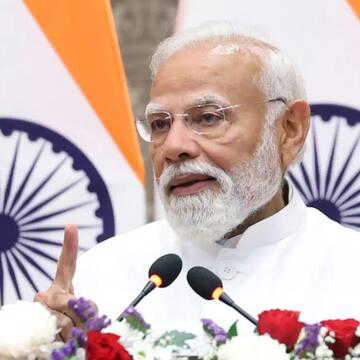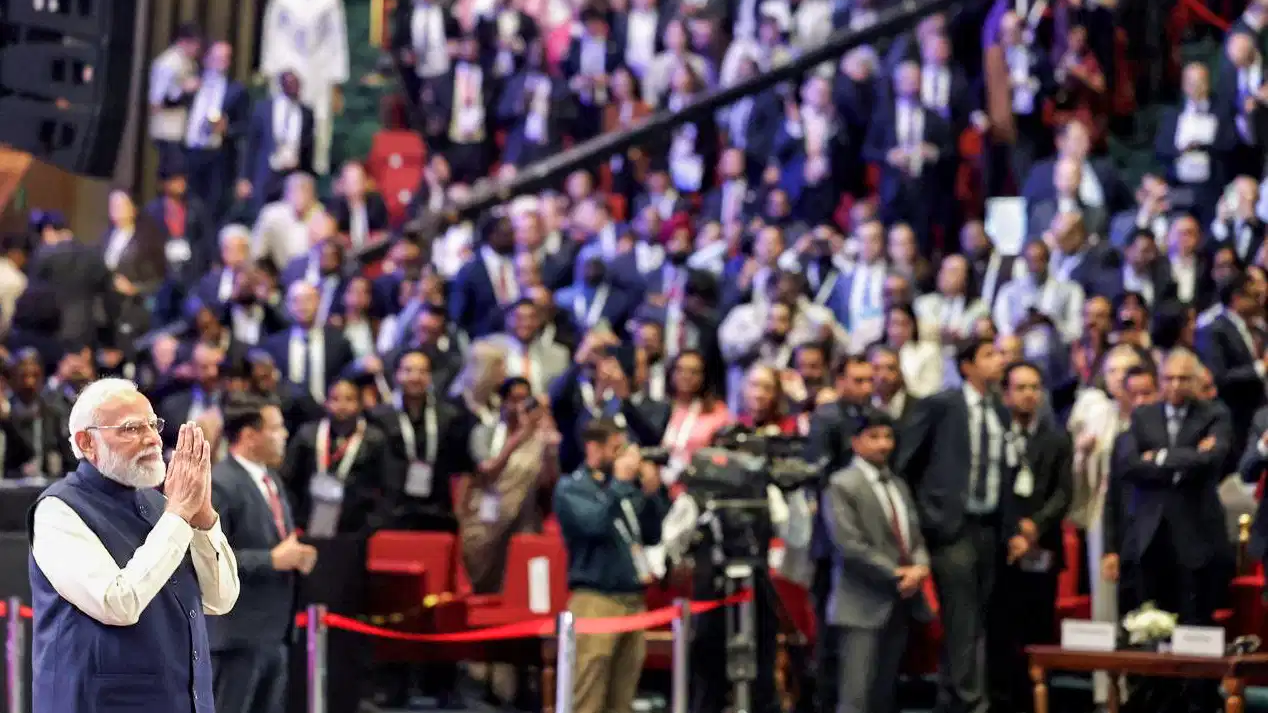
Prime Minister Narendra Modi unveiled India's new blueprint for artificial intelligence on Thursday, February 19, at the India AI Impact Summit 2026 in New Delhi. Addressing the global audience comprising policymakers, industry leaders, researchers and civil society representatives, he described it as a human-centric blueprint for AI governance in the days to come.
"Today at the New Delhi AI Impact Summit, I present the MANAV Vision for AI. MANAV means human," the Prime Minister said.
What is MANAV?
Explaining the acronym, Modi outlined five pillars that define India’s approach.
Also Read | Bill Gates to skip keynote at India AI Impact Summit amid Epstein files controversy
"M stands for moral and ethical systems. AI should be based on ethical guidance," he said.
"A stands for accountable governance, meaning transparent rules and robust oversight."
On data and sovereignty, he added, "N stands for national sovereignty. Whose data, his right," highlighting ownership and digital self-determination.
The second "A" focuses on inclusion. AI systems, he said, must be accessible and equitable. Modi stressed that AI "should be a multiplier, not a monopoly."
Finally, he explained, "V stands for valid and legitimate. AI should be lawful and verifiable."
A framework for the future
According to the Prime Minister, MANAV is not limited to India. He positioned it as a guiding framework for the global AI ecosystem. "This MANAV vision of India will become an important link for the welfare of humanity in the AI-based world of the 21st century," he said.
Also Read | AI won’t kill jobs, it will rewrite them: India bets on skills, safety and sovereignty
He also pointed to the need for stronger safeguards as AI tools become more embedded in daily life. "We have to be more cautious regarding children's safety. The AI space should also be child safe and family guided," he noted.
Calling the present moment transformative, Modi observed, "We are entering an era where humans and intelligent systems co-create, co-work and co-evolve."