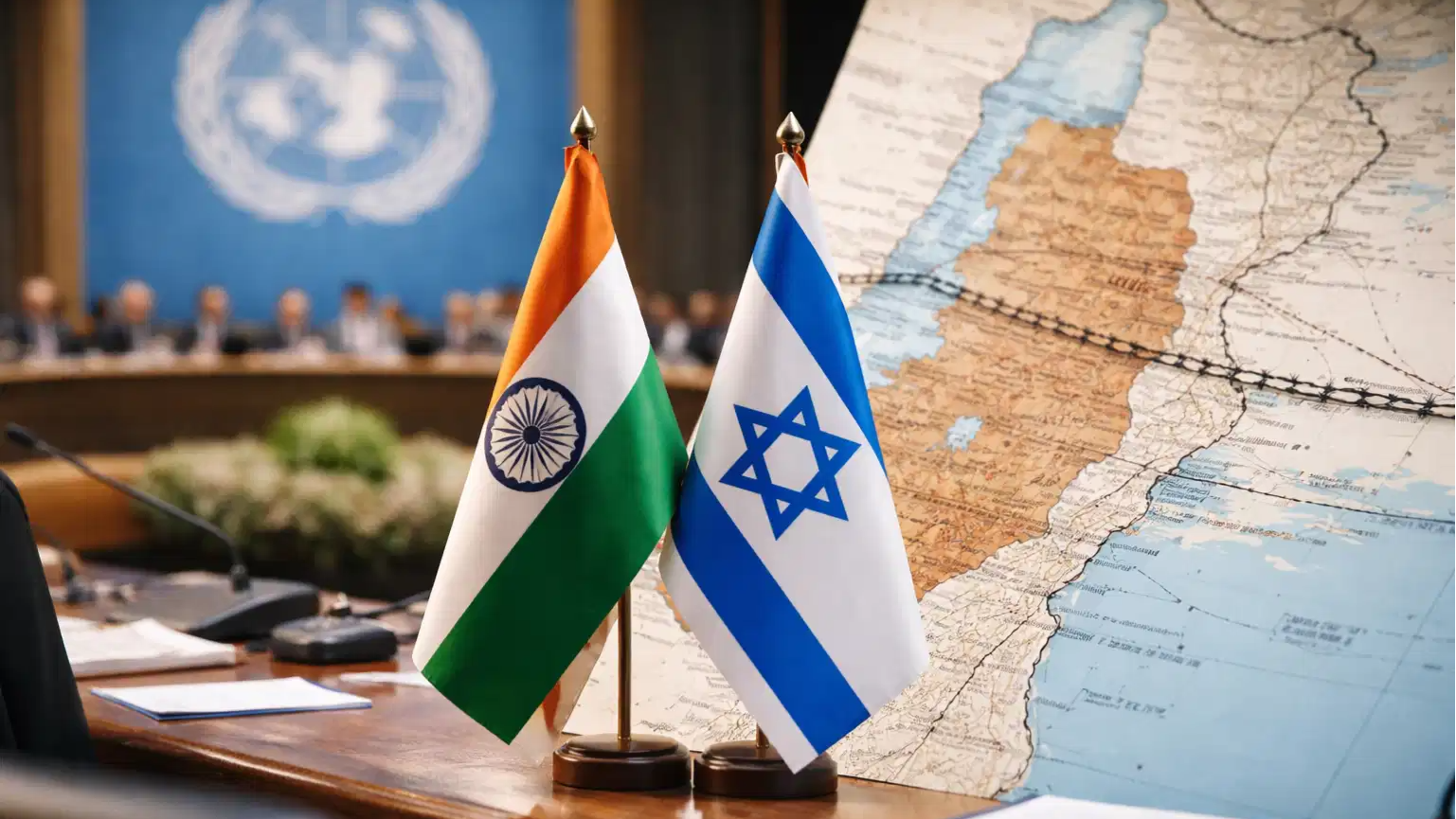
India has become the latest country to voice criticism of Israel's unilateral actions in the West Bank as it added its name to a joint statement ahead of crucial meetings in the United Nations and in Washington.
India signs joint statement
The joint statement was initially announced on February 17, 2026, with the backing of the League of Arab States, the European Union, as well as the founding members of BRICS, Russia, China, Brazil and South Africa. The statement was also backed by India's Quad partners, Australia and Japan. The country's neighbours, namely Bangladesh, the Maldives, Mauritius, and Pakistan, also supported the statement.
Also Read | After Pahalgam terror attack, CRPF establishes 43 high-altitude bases in Jammu and Kashmir
India was not one of the 85 nations that signed the statement on Tuesday but later added its backing to it. The statement was read out at a UN "stakeout" by Riyad Mansour, the Palestinian Ambassador to the UN, surrounded by diplomats from co-signing nations.
"We strongly condemn unilateral Israeli decisions and measures aimed at expanding Israel's unlawful presence in the West Bank," Mansour was quoted as saying by The Hindu.
"We underline in this regard our strong opposition to any form of annexation," he added, noting that the statement rejected all measures "aimed at altering the demographic composition, character and status of the Palestinian territory occupied since 1967, including East Jerusalem".
Concerns over new Israeli measures
In recent months, following a ceasefire in Gaza, Israel's Parliament has passed plans tightening control over land in the West Bank's "A" and "B" areas, which have been administered by the Palestinian Authority since the Oslo Accords, reported The Hindu. Measures include easing land acquisition rules and verifying documentation of current residents, steps viewed by critics as paving the way for annexation.
The Hindu quoted the joint statement, "Such measures violate international law, undermine the ongoing efforts for peace and stability in the region, run counter to the Comprehensive Plan and jeopardise the prospect of reaching a peace agreement ending the conflict."
Also Read | Bill Gates to skip keynote at India AI Impact Summit amid Epstein files controversy
Debate at home and diplomatic context
Before India joined, the absence of its name drew criticism online. Former Ambassador to Iran KC Singh called it "regrettable that India has chosen Israeli corner so blatantly", stated The Hindu report. Former Foreign Secretary Nirupama Menon Rao wrote, "Strategic autonomy was meant to expand India's choices, not shrink its moral vocabulary. If autonomy turns into avoidance of normative positions altogether, it starts looking less like independence and more like hedging."
The development comes as External Affairs Minister S Jaishankar recently met representatives of the League of Arab States and Palestinian Foreign Minister Varsen Aghabekian Shahin, and as Prime Minister Narendra Modi's proposed visit to Israel remains under discussion.