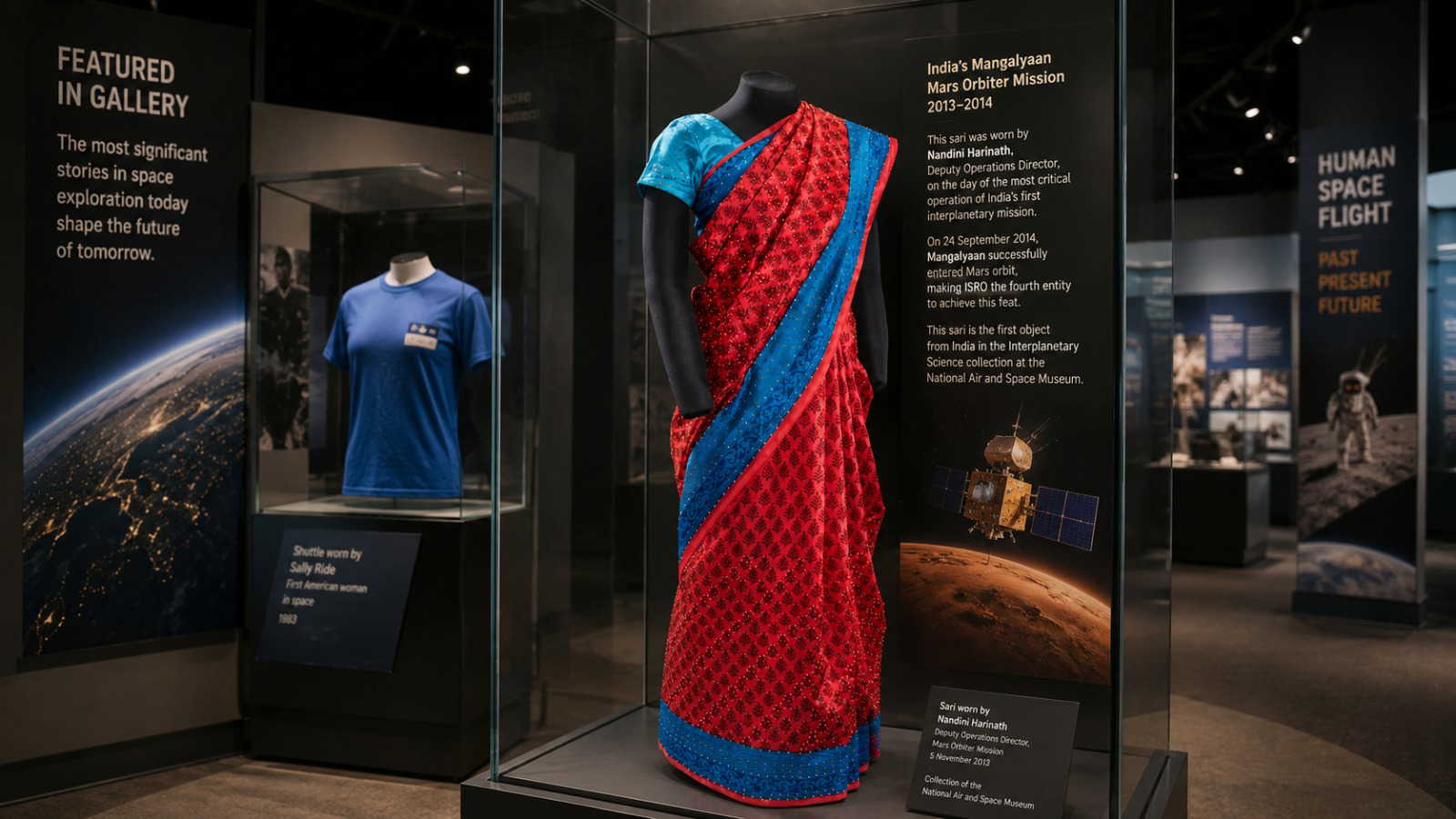
When India launched its Mars Orbiter Mission (Mangalyaan) from the Satish Dhawan Space Centre in Sriharikota, Andhra Pradesh, on November 5, 2013, millions of Indians watched anxiously, offering prayers for the mission’s success.
Inside the Indian Space Research Organisation (ISRO), scientists were equally tense, including Nandini Harinath, who served as the deputy operations director for the landmark mission.
Also Read | India condemns disruption at CJI Surya Kant’s UK lecture, calls it 'indecorous behaviour'
Symbolism of the saree
In an interview with the BBC, Harinath recalled choosing a red and blue silk saree for what she described as the "single most critical day" of the mission in December 2013. Years later, that saree became the first object from India to be included in the interplanetary science collection of the Smithsonian's National Air and Space Museum in Washington.
Harinath was among the ISRO scientists responsible for directing the spacecraft out of Earth’s orbit and onto its 300-day journey to Mars. Reflecting on the operation, she told the BBC, "It was a do-or-die moment, the most critical operation in the mission. We had to decide where the spacecraft goes, how it goes and when it goes. The success of the mission depended on what we did that day."
The mission achieved a historic milestone on September 24, 2014, when Mangalyaan successfully entered Mars orbit. The achievement made ISRO the fourth entity in the world to accomplish the feat, following the Soviet space programme, NASA, and the European Space Agency.
Alongside fellow scientists Anuradha TK and Ritu Karidhal, Harinath became a symbol of India’s growing presence in space exploration and an inspiration for young women aspiring to careers in science and engineering.
Also Read | Cheaper than petrol, but there's a catch: India rolls out E85 fuel
Scientists all over the world are amazed at these ‘Rocket Women’
Matt Shindell, a space history curator at the Smithsonian museum, told the BBC that he found the widely shared image of saree-clad women scientists celebrating the Mars mission "very compelling".
"I felt it would be a great story to tell, the story of these 'Rocket Women' who were at the front and centre of this important mission," he said.
In 2020, Shindell contacted Harinath to identify an object that could represent India’s Mars mission. "I asked her what object she'd be willing to part with. We agreed on the saree that she was wearing on the day Mangalyaan left Earth's orbit," he noted.
Today, the saree is displayed in the museum’s 'Features in Gallery' section alongside the iconic blue T-shirt worn by Sally Ride, the first American woman in space. According to Shindell, it symbolises both India’s achievement in space exploration and an inspiring personal story that could encourage more women to pursue careers in science. Visitors frequently stop to learn about the saree’s origins and its connection to India’s historic Mars mission.