What is the number of websites present in the entire world? 1.34 billion websites (out of which 201 million are active). Every minute on YouTube, 30 billion videos are posted, which would take you 500 hours to watch one after the other. Users consume 4 billion hours of YouTube Shorts daily. India is on top in the entire world when it comes to active YouTube viewers, which are 491 million. There's nothing unusual about this statistic. Since two social media sites, namely Facebook and Instagram, owned by Meta have already outrun others in this race.
Every day, almost 800 million people view 1,400 billion Facebook and Instagram Reels. Around 1,500-2,000 movies, whether big or small, were released in India alone in 2025, through an estimated 17,000 theaters and 57 OTT platforms. One lakh books are published annually in this nation.
Also Read | Kashmir tourism rebounds, but what’s happening to its disappearing lakes?
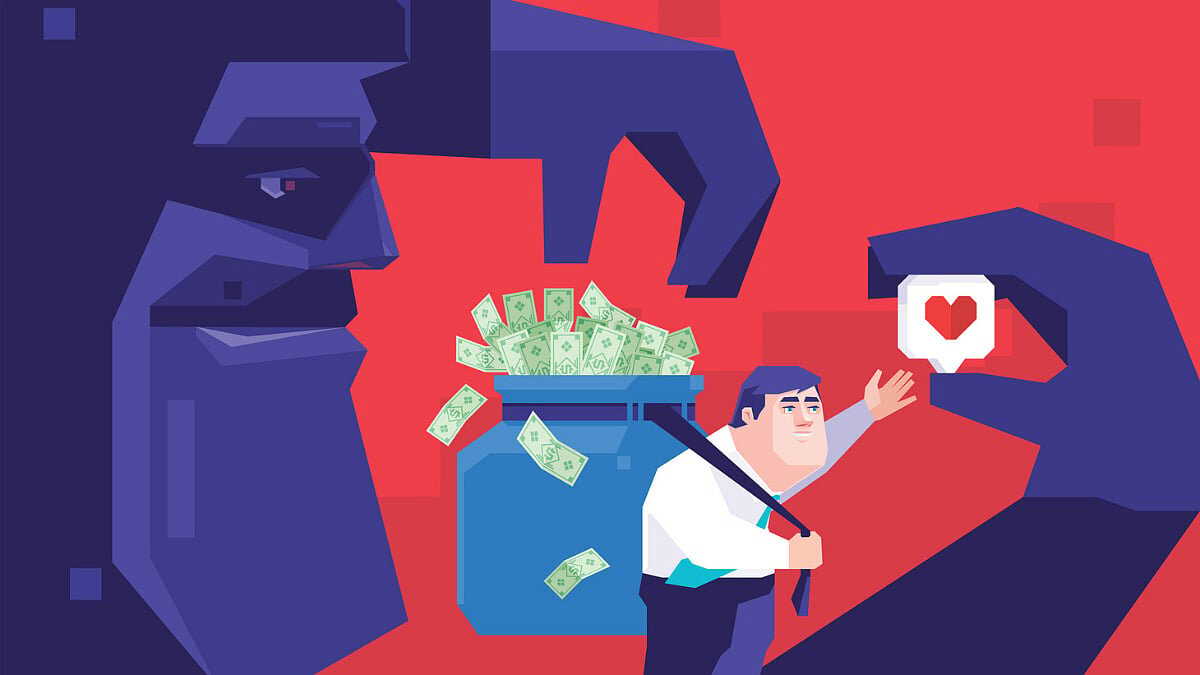
These big social media platforms, content creators, and publishers that we've been discussing all this while want only one thing—how to capture more and more viewers' or users' attention. They are called 'attention mongers'. The interesting thing is, they haven't just stopped at taking others' attention; they're turning everyone else into their own kind. Now the question might arise: 'I'm just an ordinary person. What do these big shots care about my attention!' So let's examine the relationship between attention and money in a bit more detail.
There are many social media platforms. Let's just review Facebook's statistics once. Nearly 3 billion people log into Facebook every month, from which Meta earned approximately $201 billion in 2025, which equals about 19 lakh crore in Indian currency.
Attention has emerged as the scarcest resource in the digital age
Facebook's CPC or cost-per-click rate for each advertisement is about 107 rupees, which is low compared to other platforms. So how is Facebook earning so much!
Simple calculation. They use users' attention as a resource. In economic terms, this is called the 'attention economy'. Nobel Prize-winning economist Herbert Simon first introduced the concept of the 'attention economy' in 1971.
It is assumed that information is the most important resource in the present time. Is this really so? In economic terms, an important resource is one that has demand and a shortage of supply. Research shows that about 400 million terabytes of information are created daily worldwide, and interestingly, 90 percent of the current world's information repository has been created in the last two years. One of the main reasons for this massive amount of information being produced continuously can be seen as the unrestricted use of the 'Internet of Things' and artificial intelligence. Therefore, concepts like 'information explosion' and 'information oversupply' are widely prevalent nowadays. So, whatever else may be lacking, there's no shortage of information in this age.
Then what is the shortage of? Attention. Because the kitchen that can utilize information is attention. Davenport and Beck wrote in their 2001 book 'The Attention Economy' that when society produces abundant information, there's a shortage of the attention that can properly process that information. Laura Purdue wrote in her 2017 book 'Information Literacy in the Digital Age' that until 1900, it took 100 years for civilization's information repository to double, which came down to just 13 months in 2013 and currently has come down to 12 hours. Such massive production of information and its processing initiates what is called 'Attention Deficit Disorder'.
Therefore, information literacy became essential for making correct information-based decisions. Paul Zurkowski first introduced the concept of 'information literacy' in his research paper in 1974. Information literacy gained more importance when UNESCO held discussions on this topic in Prague in 2003, in Alexandria in 2005, and in Moscow in 2012. Information literacy is the skill to feel the need for information and find the required information from among numerous information sources.
Also Read | What is social burnout? Here’s why your social battery runs out faster than before
Excessive information exhausts people. In 1996, Reuters Business Information conducted research on 1,300 managers and published their findings in a report called 'Dying for Information'. They showed that excessive use of information causes several symptoms among managers—such as reduced decision-making ability, expressions of anger and irritation, stomach and muscle pain, feelings of loneliness, disrupted sleep at night, and experiencing distress. Aren't we all victims of Information Fatigue Syndrome? Not being affected would be abnormal!
Research says that humans' attention span has now come down to 8 seconds. This was around 12 seconds even in 2000. This trend will only increase in the coming days, not decrease. Clay Johnson clearly stated in his 2015 book 'Information Diet' that information explosion is a misconception. Because abundant information doesn't create problems. Human attention actually cannot process that vast amount of information. That's the real problem. Just as eating according to a wrong diet can make people sick, similarly wrong or unhealthy information directly affects thinking. Simon had said that human attention should be used wisely. Along with information literacy, awareness about attention has therefore become very important. So the next time you spend hours watching YouTube Shorts or Facebook or Instagram Reels, you might want to think at least once—aren't you spending something very valuable in exchange? Your attention!
The author is a librarian at Derozio Memorial College