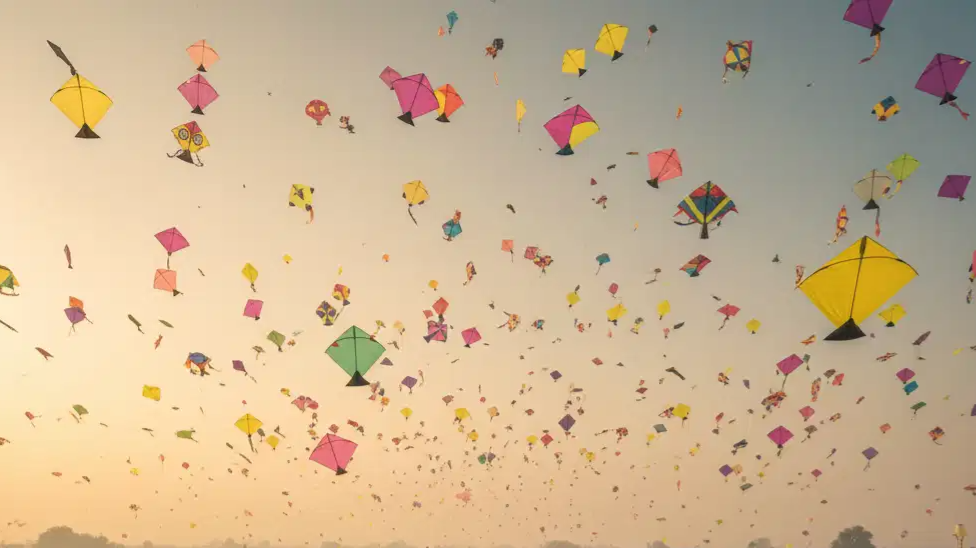
Makar Sankranti arrives every year with a quiet certainty in India. It marks the movement of the sun into Uttarayan and signals longer days, warmer light, and the end of winter’s hold. Across regions, it is celebrated differently, yet everywhere it remains a festival of harvest, renewal, and hope. In Bengal, the air fills with the smell of new rice, date palm jaggery, and freshly made sweets. Above all, the sky becomes a shared canvas, crowded with colourful kites, flying freely, crossing rooftops and neighbourhoods without asking permission. For generations, kite flying on Makar Sankranti has been more than a game. It is a ritual of joy, a claim on the sky, and a moment where childhood meets tradition.
Also Read | Ikkis review: A humane war drama that chooses compassion over spectacle
A festival of flight and memories that shape childhood
Within this grand cultural rhythm, there are small stories that rarely find space in celebration. This is one such story. A story of a kite, a journey, and a boy no older than eight or nine.
I met the boy while travelling from Hatgacha in Kalna Two block of Purba Barddhaman district. He had come there with his father to buy a kite for Makar Sankranti. It was not an ordinary purchase. The kite was large, noticeably bigger than most others, with a butterfly printed across its surface. It stood out even before it ever touched the sky. For the boy, this kite was not just paper and bamboo. It was the festival itself.
The journey back was long, nearly fifteen kilometres. The first auto took us from Hatgacha to Pathar Ghata Bridge, which marks the border of Purba Barddhaman district. Beneath the bridge flowed a small river, steady and indifferent, carrying water across boundaries humans have drawn. In that first auto, the boy sat at the back with his father, holding full responsibility for the kite. He placed it gently behind him, turning again and again to check if it was safe, if it had bent, if the wind had touched it too roughly. His entire attention rested on that kite. Roads, sounds, and strangers did not matter. Only the butterfly did. Crossing the bridge meant entering Hooghly district.
The moment a festival ended on the road
We changed autos near Pathar Gatha Bridge. The second auto was smaller and more crowded. This time, the father took charge of the kite, perhaps believing that an adult hand would protect it better. But space was tight, the wind was stronger, and care was uneven. In a moment that no one intended, the kite broke.
There was no loud sound, no sudden drama. Yet something decisive happened. The boy fell completely silent. He did not cry. He did not protest. He did not even look angry. His sadness was too deep for noise. Perhaps he could not express anger toward his father. Perhaps he knew words would not bring the kite back. But everyone in the auto felt it. Fellow passengers noticed the stillness, the lowered eyes, the sudden heaviness that filled the space. With the kite broken, the festival ended for him. He knew that this was not something that could be replaced easily. He knew how far they had travelled to buy it. He knew that the butterfly kite might have made him visible among his friends, might have helped him make new ones, might have given him a small moment of pride in the crowded sky of Sankranti.
Now it was only torn paper.
Also Read | Winter in Bolpur: Where fairs bloom, Bauls sing, and Birbhum’s soul comes alive
Yet even in loss, there was something the boy carried with him. A quiet dignity. A seriousness far older than his age. He had protected his kite with care. He had travelled far for it. He had imagined its flight. That effort itself was a form of glory. In Indian traditions, festivals often teach us not only celebration but also acceptance. The boy learned this lesson early, not through sermons or rituals, but through a broken kite on a crowded auto. That day, the sky would still be full of kites. Shouts of joy would still rise. Makar Sankranti would still be celebrated across homes and rooftops. But somewhere between Pathar Ghata Bridge and Pandua station, a child quietly grew older, carrying the weight of a festival lost and the grace of having loved a simple kite deeply.
Sometimes the truest meaning of tradition is not found in what we hold in our hands, but in what we learn to let go, without losing ourselves.
-----------------------------------------------------
Author: Atendriya Dana, Research Scholar, Department of International Relations, Jadavpur University