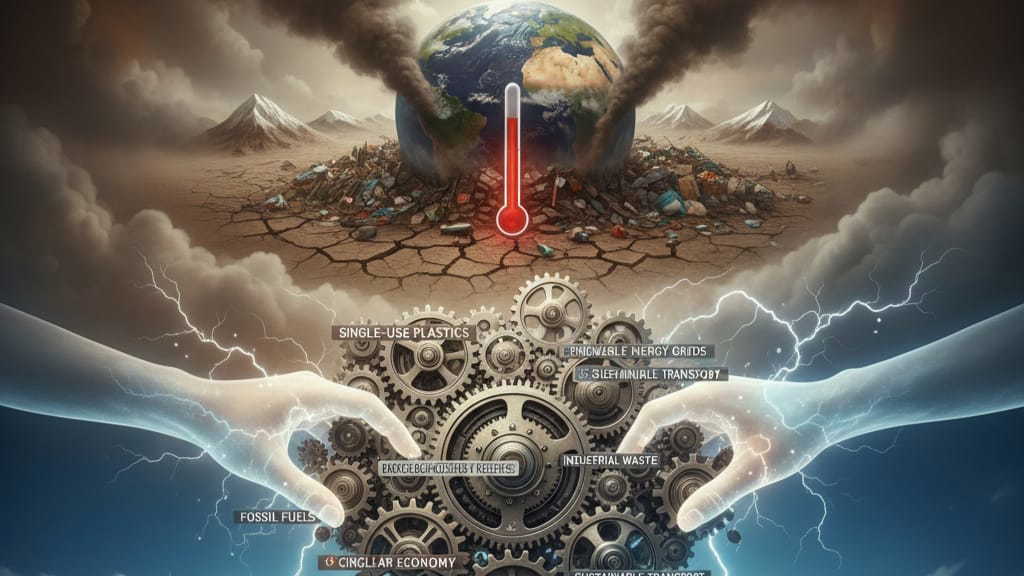
In the age of the Anthropocene, we must find ways to fight all the fires that are threatening Planet Earth: among them, climate change induced mainly by global warming is the most pressing emergency facing mankind. Climate science has by now conclusively and irrefutably demonstrated that global warming is being driven primarily by human activity. It is, thus, human ingenuity on which the onus lies to devise a solution to the problem.
On 15 December, a Supreme Court bench headed by Chief Justice Surya Kant tried to get to the root of the problem of severe air pollution in Delhi and the National Capital Region. In response to the complaint that the situation continued to be severe, it noted that the court had passed several orders but the situation hadn’t improved. It said that practical orders would have to be passed, which could be implemented.
In the course of the proceedings it analysed the situation. The chief justice said, ‘People need to understand the need of the hour and change their lifestyles. The affluent class does not comply with the restrictions and continues to use big diesel-guzzling cars, generators and other polluting gadgets. The pollution caused by vehicles is choking the national capital and surrounding areas. It is the poor and working class who are most exposed to pollution and suffer the most.’
The deeper problem
Taken at face value, the points made by the chief justice are valid. It is true that the energy-intensive lifestyles of the rich release pollutants and greenhouse gases (GHGs) which are responsible for health problems, and global warming and climate change. It is true that the affluent classes are not inclined to change their lifestyles and use of polluting machines, which means that their carbon footprint is growing rather than shrinking. It is, finally, also true that the poor and working people suffer the most from the effects of pollution, and global warming and climate change.
But behind the truth, and obviousness, of these observations lies a much deeper problem. Michael Mann, the eminent climate scientist and environmental activist, had pointed out in The New Climate War: The Fight to Take Back Our Planet, published in 2021, that it is deeply unhelpful to blame individuals or their lifestyles for the problems of pollution and climate change. The solution, similarly, does not primarily lie in fixing individual lifestyles. We shall return to this point.
In his book, Mann showed that the fossil-fuel lobby has used creative strategies to prevent humanity from moving towards a greener future. In the early years of the environmental movement, when climate activism took off, the lobby promoted outright denial. Thus, the big corporations involved in extracting, processing and distributing fossil fuels – Big Oil – began to fund spurious ‘think tanks’ and ‘research institutes’ that started putting out cooked data, misrepresentations and unsupported claims to discredit the movement to ‘decarbonize’ the economy and promote cleaner and greener ways of living — this was the high period of climate-change denial.
Also Read | Worshipping Gods, rising insecurities, and social service schemes in India
Devious plans of the fossil fuel lobby
When climate science came of age, with sophisticated methods being developed and complete datasets being constructed, this kind of denial became impossible. With nowhere to run, the fossil-fuel lobby developed more devious and complex ways of undermining climate science and activism. Mann showed that one of the ways was to shine the spotlight on individual lifestyles to imply these were the primary cause of pollution, global warming and climate change. Advertising blitzes and media capture helped promote the argument that individual responsibility was the main way of solving the problem. The fossil-fuel lobby tried, often very successfully, not only to deflect attention away from the primary problem of the continued extraction and use of fossil fuels and the role of corporations in blocking government regulation that could reduce them but also to create divisions among climate activists.
For some climate activists and groups, personal carbon purity became an article of faith, which led to public shaming, scolding and pointless bickering over totally irrelevant issues. Many sought the moral high ground at the cost of others.
No one in his or her right mind would argue that lifestyles and personal choices are not important. It is crucial that individuals take responsibility to reduce pollution and GHG emissions by changing their lifestyles. There is a great need for disseminating awareness among people all over the world about sustainability in general and living low-carbon lifestyles in particular. While this applies most forcefully to the high-consumption, affluent upper classes, it also applies to others. For instance, it is not just vehicles that cause pollution and emit GHGs, burning biomass and plastics, which the poor are forced to do to keep warm, cook and repel insects, also cause pollution and emit GHGs.
Systematic problem
The point, then, is that the problem is systemic. If humankind has to reduce atmospheric pollution to improve the health if people, especially in urban or urbanizing areas, there has to be a big push to change the infrastructures that support our lives and ways of living. And individuals cannot do that. Governments alone can do what needs to be done to phase out fossil fuels and move towards decarbonizing the planet.
Let’s take one example. It is not enough to say that people should opt to use public transport in preference to personal vehicles. People will not do so if it is inconvenient and uncomfortable, or, at times, just unrealistic. Governments have to provide incentives, in the form, say, of a cheap, comfortable and citywide public transport system, and disincentives, in the form, say, of high parking fees, high taxes on cars, etc.
Also Read | Winter in Bolpur: A quiet warmth of red soil, and Rabindra nostalgia
Our role in solving the problem
Behind this, there has to be the will on the part of the political class and the bureaucracy to take on the power of the fossil-fuel lobby. The main role that people have to play is pushing governments to do this by mobilizing for the environment and the right to clean air and sustainable lives.
It is also extremely important that the international community come together to fight the problem. In our globalized world, individual countries cannot fix the problem. The multilateral system has so far failed to make the kind of impact necessary to save the planet. The global negotiation system must be significantly upgraded.
There is a debate among climate activists about how far it is possible to fight Big Oil under the regime of capital. It is true that progress has to be made under capitalism, because it is here to stay as a global system for the foreseeable future. But it is also true that capitalism has to be radically reformed if the problem of pollution in particular, and global warming and climate change in general are to be reduced. Meaningful and holistic change will not be possible under conditions of the rampant growth of monopoly capitalism.
Also Read | Dyed in blue, drenched in hope: Walking in the white silence of Gurudongmar
In other words, people must organize not just to ditch their cars and generators, but to fight the power of big corporations to take control of their lives. Unrestrained corporate power promotes cronyism and bad choices at the macroscopic level. It also distorts political systems and disempowers the mass of people.
Individual ethical choices are important, but we cannot afford to miss seeing the structural problems to shame our neighbours. Many of the bad choices people keep make are forced on them.