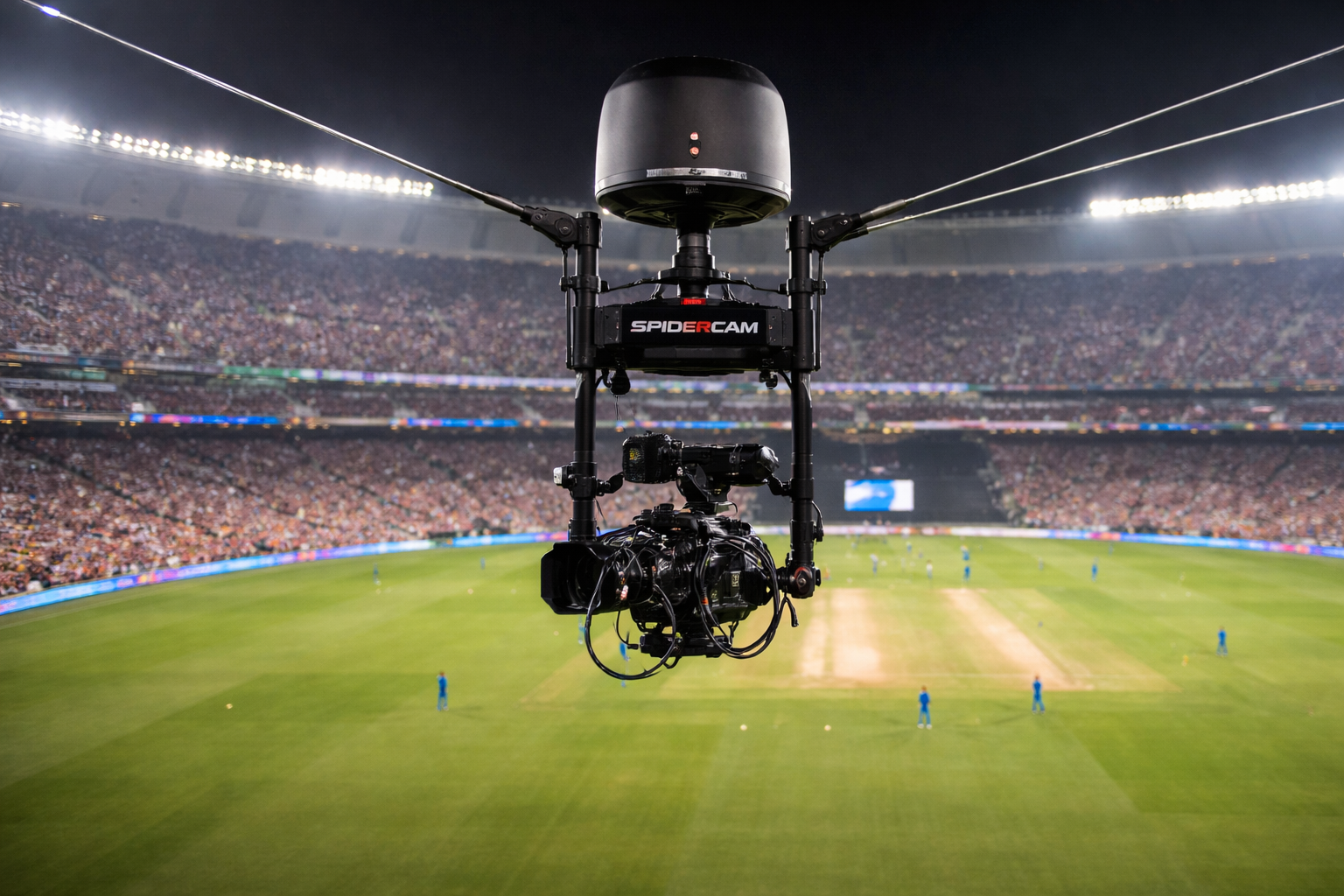
Viewers watching the ICC Men’s T20 World Cup final between India and New Zealand at the Narendra Modi Stadium in Ahmedabad may have noticed a camera gliding smoothly above the pitch, moving from one end of the field to the other. The device, known as Spidercam, has become one of the most striking pieces of technology used in modern sports broadcasting.
Suspended on cables high above the field, the system allows television cameras to capture sweeping aerial shots of the stadium while following the flow of the match in real time.
Broadcasters deployed the technology during the World Cup final to enhance the viewing experience for millions watching around the world.
Also Read | OpenAI upgrades Codex with GPT-5.4: What the new coding assistant can do
What is Spidercam and how does it work?
Spidercam is a cable-suspended aerial camera system designed to move freely across a defined area of a stadium. The camera hangs from cables attached to four motorised winches positioned at the corners of the venue, allowing it to move both horizontally and vertically above the field.
Because of this setup, the camera can glide smoothly across the playing area, providing dramatic bird’s-eye perspectives that traditional broadcast cameras cannot capture.
The system can follow the trajectory of the ball, zoom in on players during crucial moments, and capture celebrations and crowd reactions from angles rarely seen before.
During the T20 World Cup final in Ahmedabad, the Spidercam moved across the stadium to deliver close-ups, panoramic views and dynamic replays, helping television audiences feel closer to the action on the field.
Why Spidercam has become vital in sports broadcasting
Over the years, Spidercam has become a key tool in covering major sporting events, including cricket tournaments, football matches and large stadium spectacles.
The system allows broadcasters to capture sweeping visuals that show field placements, bowling run-ups and crowd reactions in a single frame. It also improves storytelling during live coverage by enabling dramatic tracking shots and immersive replays.
For fans watching at home, the aerial perspective helps recreate the sense of being inside the stadium.
Challenges and safety concerns
Despite its advantages, the Spidercam system is not without challenges. The equipment requires precise coordination between operators and match officials to ensure that it does not interfere with play.
Also Read | No internet? No problem: New app lets you send messages via Bluetooth
Players have occasionally raised concerns about the camera moving too close to the field during matches. The system is also expensive to install and operate, requiring specialised infrastructure and technical expertise.
Even with these challenges, Spidercam remains one of the most innovative technologies used in modern sports broadcasting.