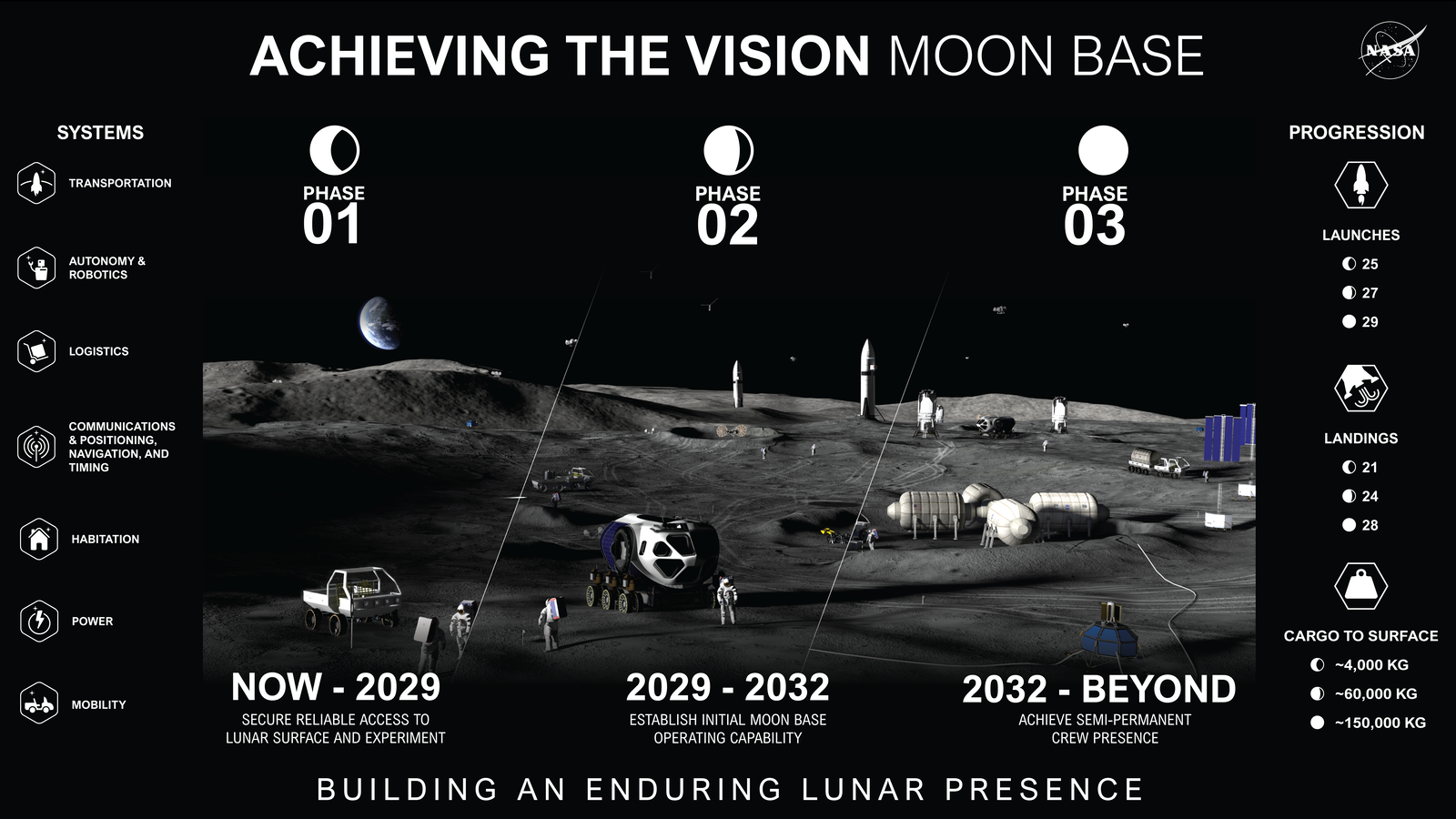
NASA has unveiled a dedicated website for its ambitious Moon Base programme, a long-term effort aimed at establishing a permanent American presence near the Moon's South Pole. Valued at around $20 billion, the project is designed to create what the agency describes as humanity's first lunar home, where future Artemis astronauts could live and work for extended periods.
Three-phase plan for a lunar outpost
The newly-launched website outlines a roadmap that stretches beyond the next decade and is divided into three phases.
The first phase, running until 2029, focuses on exploration and technology testing. NASA plans to conduct up to 25 missions, including 21 lunar landings, to study the South Pole region and prepare for future habitation.
Also Read | Meta eyes binge-watch culture with new Reels series feature on Instagram and Facebook
Crewed and autonomous rovers will be deployed alongside four MoonFall drones. The agency also plans to test nuclear radioisotope heater units capable of surviving the Moon's harsh two-week-long nights.
During this period, around four tons of payload are expected to reach the lunar surface, supported by communications relays and observation satellites.
Infrastructure takes shape after 2029
The second phase, scheduled between 2029 and 2032, will shift attention toward building semi-permanent infrastructure. NASA plans to transport up to 60 tons of cargo through 24 separate landings using a mix of low-, medium and heavy-class landers.
The agency also intends to deploy larger solar arrays, upgraded rovers and early habitation systems. Initial nuclear surface power systems, potentially including fission reactors, are also expected to be introduced during this stage.
Also Read | God of War Laufey rewrites the saga with Faye at the centre of a mythological afterlife war
Living on the Moon becomes the goal
From 2032 onwards, the project enters its third phase. This is when regular crew rotations and long-term habitation are expected to begin. Larger living modules will support astronauts, while approximately 38 tons of cargo are planned to be delivered annually to keep the base operational through each lunar night.
Before astronauts return to the Moon, three uncrewed Moon Base missions are planned for 2026. These include Blue Origin's Blue Moon Mark 1 Endurance lander, Astrobotic's Griffin lander carrying Astrolab's FLIP rover, and Intuitive Machines' Nova-C Trinity mission.
Although Artemis II completed its crewed flyby in April, NASA's current timeline does not anticipate astronauts landing on the lunar surface until 2028.