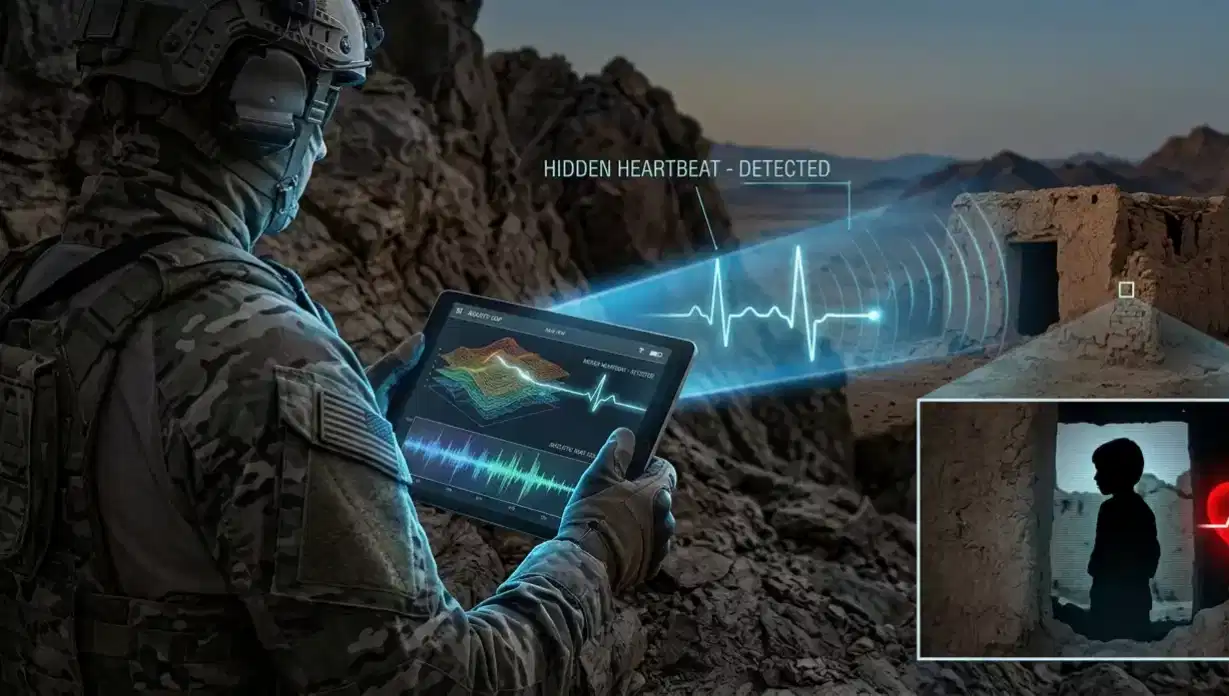
A rescue mission inside Iran has put an unusually secretive piece of US intelligence technology in the spotlight. According to reports, a downed American airman was tracked with a classified CIA tool known as “Ghost Murmur” after his F-15 fighter jet was shot down in southern Iran. The airman, identified publicly as “Dude 44 Bravo,” reportedly spent two days hiding in a mountain crevice while Iranian forces searched the area.
Also Read | Iran shuts Strait of Hormuz after Israel launches 100 strikes in Lebanon in 10 minutes
The tool was developed by Lockheed Martin’s Skunk Works division—a famously secretive advanced development division—which uses quantum magnetometry plus AI to detect the electromagnetic signature of a human heartbeat from long distances. This was not a simple extraction. President Trump has labelled it as the "most daring search and rescue mission in US history."
A daring escape
The rescue involved dozens of aircraft and hundreds of personnel, with the first aviator rescued within hours and the second extracted nearly two days later. During the operation, an A-10 was hit by enemy fire, and later, helicopters also came under attack. US officials said the mission still ended without American fatalities.
Wounded and alone, the airman "Dude 44 Bravo" spent around two days hiding in a mountain fissure as Iranian forces searched the area. He had turned on a combat survivor evader locator beacon manufactured by Boeing, but the signal was insufficient to pinpoint his location. The beacon actually became useful in a different way: to transmit it, he had to briefly emerge from the crevice. That movement gave Ghost Murmur its confirmation window.
How the ghost murmurs
A human heartbeat gives off an electromagnetic signal so faint that, under normal conditions, it can be picked up only by sensors placed almost directly against the chest, the kind of reading associated with a hospital, not a battlefield.
Also Read | Why Lebanon is still burning despite Iran-US ceasefire deal; Tehran flags 3 violations by US, Israel
What made Ghost Murmur possible, according to reports, was a leap in quantum magnetometry: sensors built around microscopic defects in synthetic diamonds. That advance has reportedly pushed detection range far beyond what was once thought feasible, allowing the system, in the right conditions, to pick up a target from as far as 40 miles away. The system combines artificial intelligence with advanced sensing technology to detect the electromagnetic signature of a human heartbeat, even across vast distances. Using long-range quantum magnetometry, it isolates these signals from background noise and identifies a specific individual.
The stated deployment of "Ghost Murmur" indicates a new frontier in surveillance and rescue operations powered by AI and quantum sensing; however, details remain limited.