





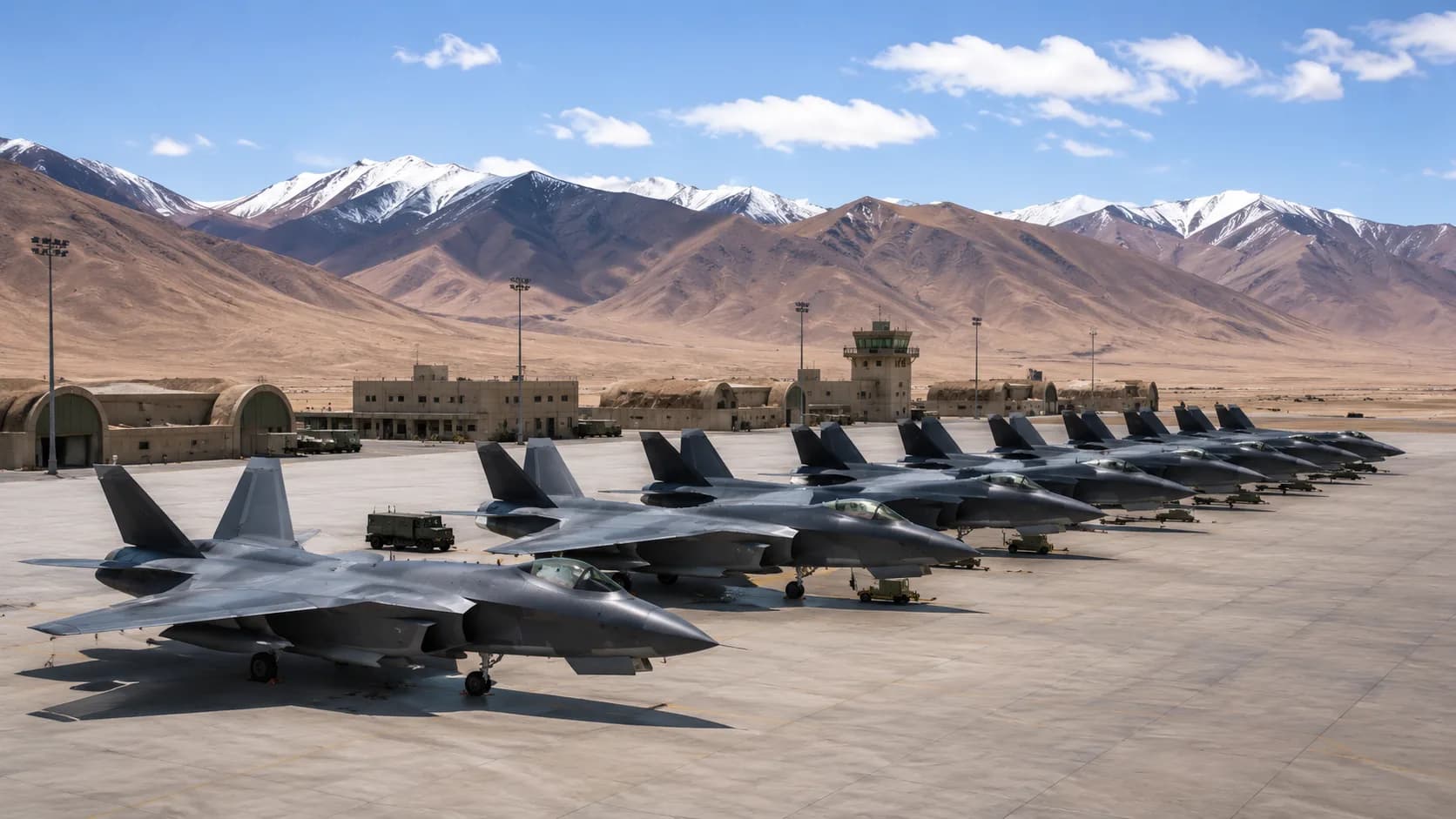


















China has expanded the operational deployment of its frontline J-20 ‘Mighty Dragon’ stealth fighter jets at airbases located close to the Indian border, according to satellite images sourced from Vantor.
The images, captured in late June and early July, show a total of 11 J-20 stealth fighters stationed across two strategically located Chinese airbases. On July 9, seven J-20 aircraft were seen parked on the tarmac at Hotan airbase in China’s Xinjiang Uyghur Autonomous Region. The dual-use military and civilian base is around 389 km northeast of Leh and approximately 245 km from the Indian Air Force’s Daulat Beg Oldie airfield in Ladakh.
Commercial satellite imagery accessed by NDTV indicates that this is the largest concentration of J-20 stealth fighters observed at a Chinese airbase facing India so far.
Also Read | AI and politics: Tech firms pour millions into US midterm election battle
A separate satellite image also showed four J-20 fighter jets positioned at Damxung airbase in Tibet’s Lhasa prefecture, located about 344 km northwest of Tawang in Arunachal Pradesh.
Experts highlight changing air power dynamics
Commenting on the deployment, Sameer Joshi, former fighter pilot and co-founder of aerospace and defence company NewSpace, told NDTV that Seven “J-20s at Hotan and four at Damxung confirm that fifth-generation operations from high-altitude bases facing India are now routine for the PLAAF, not signalling.”
He further added, “For the IAF, a low-observable threat on the northern front is now the baseline – and that sharpens the urgency of our counter-stealth sensors, integrated air defence and standoff strike capability.”
The J-20 is China’s fifth-generation stealth fighter and is designed to reduce radar detection, giving it an advantage in contested airspace. India currently does not operate a stealth fighter. Its indigenous Advanced Medium Combat Aircraft (AMCA) programme is still expected to take several years before entering operational service, subject to successful flight testing and technology validation.
China’s J-20 fleet continues to expand
The deployment comes as China’s J-20 fleet continues to grow rapidly. A report by The War Zone noted that the number of J-20 aircraft increased from around 50 in 2019 to nearly 200 by the end of 2022. Production is estimated to have accelerated further, with around 120 aircraft being built annually by late 2025. Various estimates now place the fleet at between 300 and 500 aircraft across more than a dozen PLAAF units by mid-2026.
The UK-based Royal United Services Institute has projected that China could operate nearly 1,000 J-20 fighters by 2030.
Air Marshal Narmdeshwar Tiwari (Retd) said, “I can only say that having a capacity to produce 125 planes per year speaks volumes of their advanced manufacturing capability.”
“They are producing it almost like commercial aircraft, which can only happen when the supply chain is fully integrated, very exacting manufacturing tolerances are met by all suppliers and top quality human resource is available to sustain this enterprise,” Tiwari told NDTV.
Also Read | Europe wildfires: Over 300,000 evacuated as France, Spain battle massive blazes
Explaining the broader picture, he said, “In short, they envisioned a national roadmap, put an empowered team to execute it and provided persistent support to make it happen. To prove to the world that they can compete with the best. It has been a national mission for them. After the first Gulf War, they realised the importance of air power and worked in a mission mode to achieve it.”
India’s current fighter fleet
India currently operates 36 Rafale fighter jets across two squadrons based in Ambala and Hasimara. The Indian Navy has also ordered 26 Rafale-M aircraft, while discussions are underway with Dassault for the procurement of 114 additional Rafale fighters for the Indian Air Force.
Apart from the Rafales, the IAF continues to rely on more than 260 Sukhoi-30MKI fighters, along with Mirage 2000 and MiG-29 aircraft. NDTV reported that its queries to the Indian Air Force regarding the latest Chinese deployments did not receive a response.
FAQs:
Why is China’s deployment of J-20 stealth fighter jets near India significant?
The J-20’s stealth capabilities and deployment near India’s borders strengthen China’s air power and pose a new operational challenge for the IAF.
When will India’s AMCA stealth fighter enter service?
India’s Advanced Medium Combat Aircraft (AMCA) is still at least a decade away from operational service, subject to successful testing and technology validation.
