







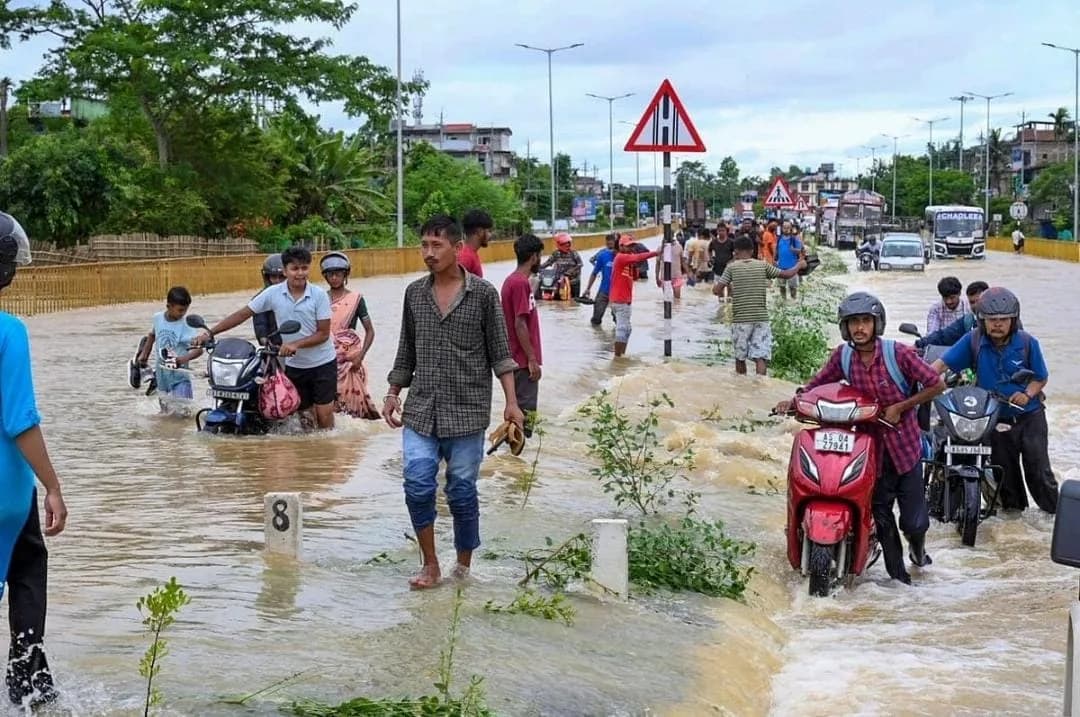













The flood situation in Assam remains critical despite signs of improvement, with over 4.45 lakh people still affected across six districts and the death toll rising to 68. While water levels have begun receding in several areas, hundreds of villages remain submerged, leaving thousands displaced and causing widespread damage to homes, roads, farms and schools.
Also Read | NCPCR to Meta: Why wasn’t child sexual abuse content reported to police?
According to the Assam State Disaster Management Authority (ASDMA), 4,45,495 people have been impacted in Sivasagar, Golaghat, Charaideo, Jorhat, Nagaon and Kamrup (Metropolitan). The number of affected people has declined from over five lakh reported on Sunday, indicating gradual improvement in the overall flood situation.
Charaideo and Sivasagar remain the worst-hit districts
Charaideo continues to be the worst-affected district, with around 1.88 lakh people impacted, followed by Sivasagar, where nearly 1.44 lakh residents remain affected. As of Monday evening, 631 villages across 21 revenue circles were still underwater.
The floods have also devastated agriculture, with more than 37,139 hectares of cropland submerged. Over 2.56 lakh livestock have been affected, while more than 26,000 animals have reportedly been washed away.
Homes, roads and schools suffer extensive damage
Floodwaters have caused significant damage to infrastructure across Assam. Several road stretches in Jorhat, Sivasagar and Charaideo have been overtopped or eroded, disrupting connectivity.
The disaster has also affected housing, with 171 homes completely destroyed and another 4,667 partially damaged. Educational institutions have not been spared either, as several schools in Sivasagar and Jorhat have reported flooding and structural damage.
Also Read | PM Modi announces Nandan Nilekani-led panel to make exams ‘reliable’ and ‘transparent’
Meanwhile, the Dhansiri (South) river at Numaligarh continues to flow above the danger mark, although no river has crossed its highest flood level.
Residents struggle for food and drinking water
People living in the worst-hit areas continue to face severe hardships. Several families have reported that floodwaters entered their homes within hours, leaving them with little time to save their belongings.
Residents have also complained about shortages of food, safe drinking water and shelter as relief efforts continue.
Relief operations continue across the state
The Assam government has opened 184 relief camps and distribution centres, while teams from the State Disaster Response Force (SDRF), National Disaster Response Force (NDRF) and local administration are carrying out rescue operations using boats to evacuate stranded residents.
Relief materials, including rice, dal and salt, are being distributed in the worst-affected districts.
Chief Minister Himanta Biswa Sarma said electricity restoration is being carried out in phases after power supply was suspended as a safety measure during the floods. Power department teams are conducting safety inspections before reconnecting electricity in affected areas.
Political leaders call for long-term flood management
Congress president Mallikarjun Kharge expressed condolences to the families who lost loved ones in the floods and urged the Union and state governments to strengthen rescue, relief and rehabilitation efforts.
Leader of Opposition Rahul Gandhi also called for a robust, long-term flood management system, stressing the need for scientific planning, stronger infrastructure, effective early warning systems and better rehabilitation measures to reduce the impact of recurring floods in Assam.
FAQs
How many people have been affected by the Assam floods?
According to the Assam State Disaster Management Authority (ASDMA), around 4.45 lakh people have been affected across six districts.
Which districts are the worst affected by the floods?
The worst-hit districts include Charaideo, Sivasagar, Golaghat, Jorhat, Nagaon and Kamrup (Metropolitan), with Charaideo reporting the highest number of affected residents.
