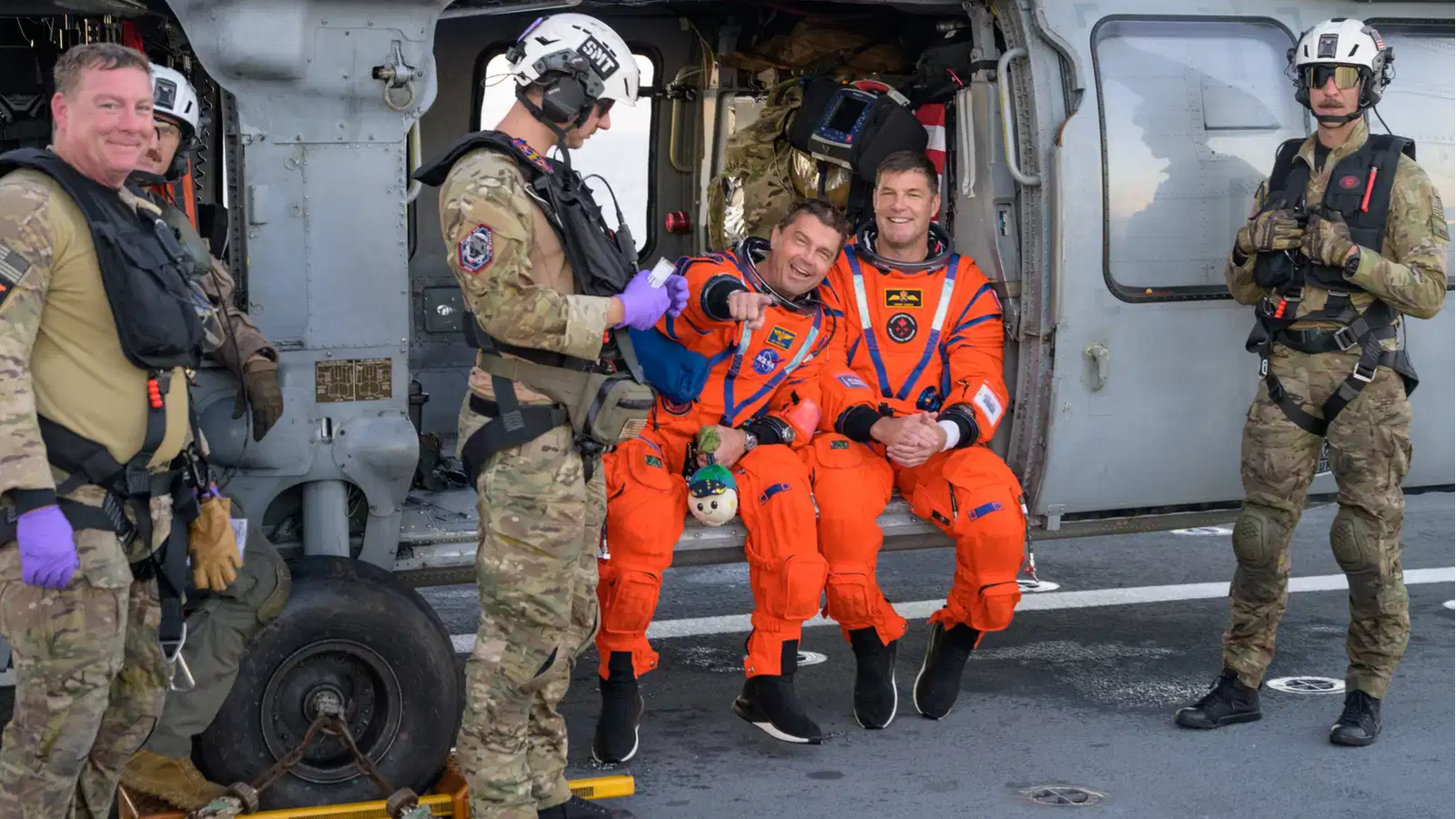
NASA's Artemis II, the first crewed mission under its Artemis mission and the first human flight around the Moon in over 50 years, has reached its successful conclusion. The Orion capsule carrying the Artemis II crew splashed down in the Pacific Ocean just after 8 pm EDT as planned.
The capsule carried NASA astronauts Reid Wiseman, Victor Glover, and Christina Koch and CSA (Canadian Space Agency) astronaut Jeremy Hansen after completing their historic journey of 1,17,659 km to the Moon and back.
Also Read | ‘I might’: Kamala Harris hints at 2028 White House run
US President Donald Trump responded soon after the return, congratulating the crew on Truth Social and calling the mission “spectacular”. He added that he looked forward to meeting the astronauts at the White House and said, “We’ll be doing it again and then, next step, Mars!”
Crew safely extracted after splashdown
Following the splashdown, the four astronauts were safely retrieved from the Orion spacecraft and taken aboard the USS John P. Murtha for post-mission medical checks. NASA confirmed the development in a statement on X, saying the crew had been extracted and would be escorted to the medical bay for routine evaluations.
NASA earlier shared updates on the crew’s final descent preparations, posting on X (formerly Twitter), “Fist bump! The Artemis II crew is now under 35,000 miles from Earth. The astronauts are preparing the spacecraft for reentry, and the weather is looking good for splashdown.”
Also Read | Sam Altman’s home attacked with Molotov cocktail; OpenAI receives threat, suspect nabbed
The mission also drew attention from orbit, with astronauts on the International Space Station observing the re-entry. NASA astronaut Chris Williams said the crew saw a bright streak as the spacecraft returned through Earth’s atmosphere, adding that they were “overjoyed” to know their colleagues had safely completed the mission.
Going the distance
On Monday, April 6, the Artemis II crew swept around the far side of the Moon in a high-stakes dress rehearsal for the landing missions to come. Their lunar flyby took them farther than any humans have ever traveled before, surpassing the previous distance record of 4,00,171 kilometre set by Apollo 13 astronauts in 1970.
NASA said the Artemis II crew also captured a rare "Earthrise" image during their lunar flyby, showing Earth appearing to dip behind the Moon’s horizon from the spacecraft’s vantage point. The image, taken from the Moon’s far side, a region not visible from Earth, echoes the iconic “Earthrise” photograph from the Apollo 8 mission and highlights the unique perspective astronauts experienced during the journey.
Officials said the mission’s primary objectives included validating systems for crew safety, demonstrating operations for future lunar missions, and collecting data for upcoming deep space exploration efforts.