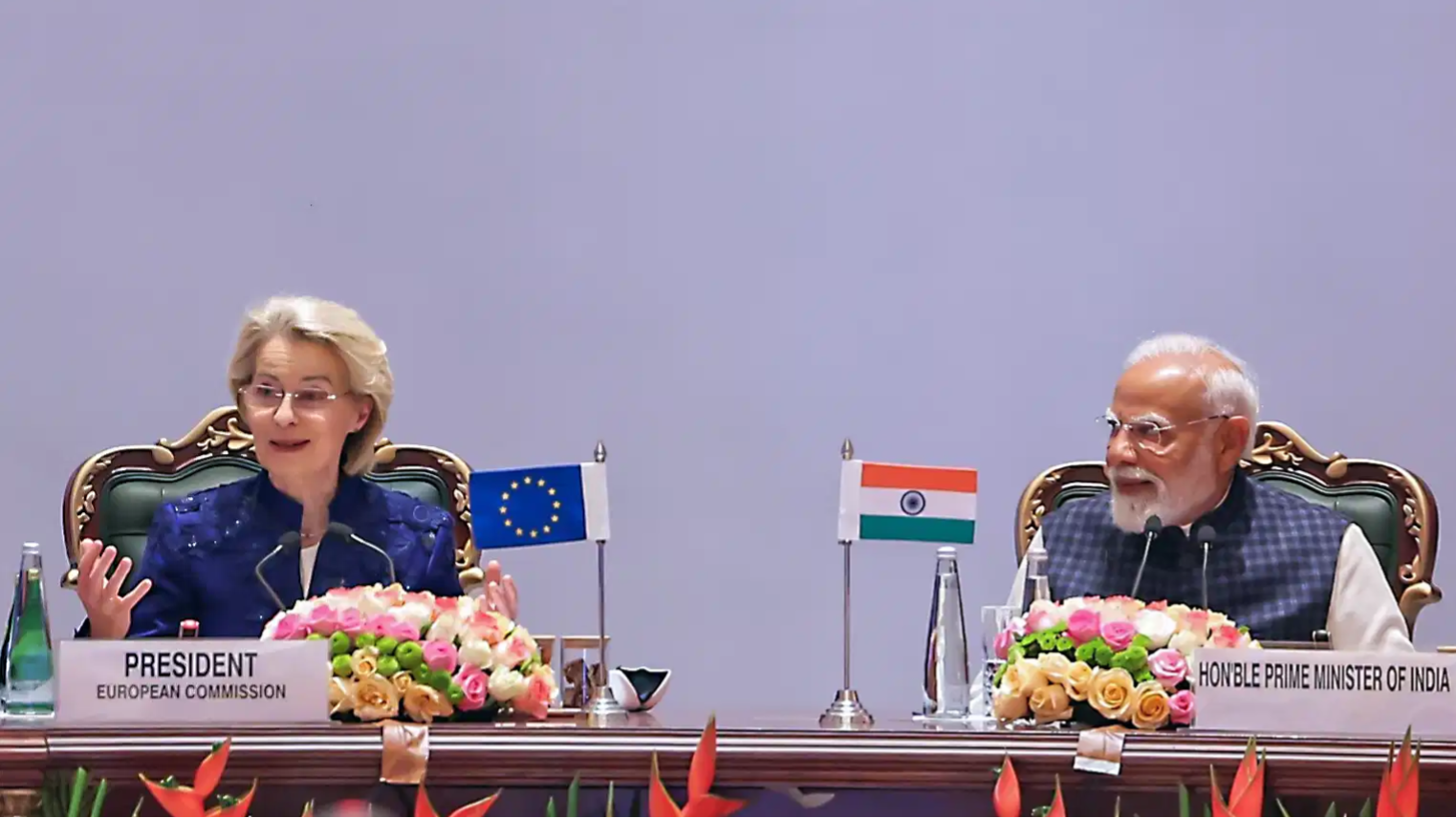
India’s newly concluded free trade agreement with the European Union is expected to give fresh momentum to Prime Minister Narendra Modi’s push to turn the country into a global manufacturing hub, while offering exporters relief from steep US tariffs.
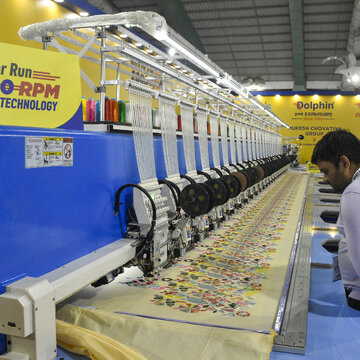
Described by negotiators on both sides as the “mother of all deals”, the pact will see the EU eliminate or sharply reduce tariffs on 99.5% of goods imported from India. That includes a phased removal of duties on labour-intensive products such as apparel, leather goods and furniture, sectors that have struggled after the United States under President Donald Trump imposed 50% tariffs on Indian goods.
Also Read | Is the stock market open on Budget Day 2026? Here's what we know about NSE, BSE operations on Feb 1
According to a Bloomberg report, the agreement opens one of the world’s largest consumer markets more widely to Indian manufacturers at a time when many exporters are trying to cut dependence on the US.
Relief for exporters, new openings for manufacturers
Farida Group, one of India’s largest shoemakers, expects its Europe sales to rise 10–20% once the pact takes effect. Managing director Israar Ahmed told Bloomberg that the EU and UK agreements together create a large consolidated market and could push Europe’s share of the company’s exports to as much as 60%.
Economists say the gains could be meaningful over the medium term. Radhika Rao of DBS Bank estimated that India’s exports to the EU, which currently account for over 17% of total shipments, could grow 5–7% this decade. That could lift Europe’s share above 20% and potentially overtake the US as India’s top export destination, Bloomberg reported.
Markets reacted quickly. Textile stocks rose after the announcement on expectations of lower duties and stronger order books, while defence and engineering firms gained on hopes of deeper industrial and technology ties with Europe.
Also Read | ‘Free trade for ambitious India’: PM Modi hails India–EU trade deal as opportunity for youth
Industry bodies also see the deal as a signal to global manufacturers looking to diversify away from China. Ajay Sahai of the Federation of Indian Export Organisations told Bloomberg that zero tariffs would encourage foreign firms to produce in India for export to Europe and beyond.
Auto-component maker Super Auto Forge said easing of non-tariff barriers and paperwork would particularly help engineering, aerospace and defence manufacturing. “India will now emerge as not just China-plus-one but Europe-plus-one too,” executive vice chairman Muralishankar Sambasivam told Bloomberg.
Boost to ‘Make in India’ amid global shifts
The agreement comes as India tries to revive its manufacturing drive. The sector’s share of the economy has slipped to about 13% from 16% in 2015, according to World Bank data cited by Bloomberg, which is well below the 25% target envisioned under the “Make in India” programme.
Recent trade deals, led by the EU pact and an earlier agreement with the UK, are seen as steps to integrate India more deeply into global supply chains and counter the drag from US tariffs, which have widened the trade deficit and weakened the rupee.
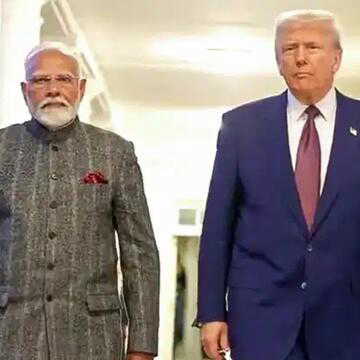
Talks with Washington to ease those tariffs are ongoing but still remain uncertain. Shortly after the EU deal was unveiled, the US trade representative said that India still needs to address American concerns over its purchases of Russian oil before tariff relief could be considered.
Even so, analysts argue that diversifying trade partners reduces risk. Deutsche Bank economist Kaushik Das told Bloomberg that India would benefit from pursuing “multi-alignment and strategic autonomy in trade” while negotiations with the US continue.
For exporters hit by punitive US duties, the EU opening offers an immediate alternative. For the government, it strengthens the case that India can position itself as a trusted, cost-competitive manufacturing base for Western markets.