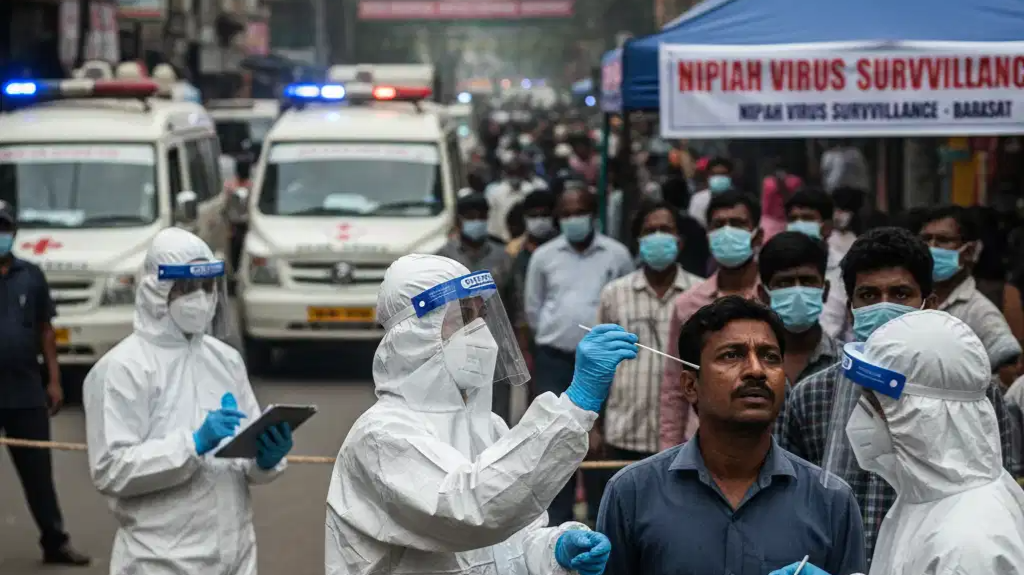
Health authorities in West Bengal are on alert after two suspected cases of Nipah virus infection were reported from Barasat in North 24 Parganas district. The patients including a male and a female are undergoing treatment at a private hospital where both are employed as nurses.
A senior official of the State Health Department confirmed to PTI that samples from both patients have been sent to AIIMS Kalyani for testing. “Both nurses work in the same hospital in Barasat. Preliminary reports indicate a possible Nipah infection,” the official said, adding that further confirmation is awaited.
Also Read | India launches logo, website for BRICS Presidency 2026; S Jaishankar outlines four priorities
In response, a national joint outbreak response team has been deployed to assist the State government in containment and public health measures. The team includes experts from the National Institute of Virology (NIV), Pune; National Institute of Epidemiology (NIE), Chennai; AIIMS Kalyani; All India Institute of Health and Public Hygiene, Kolkata; and the Department of Wildlife under the Ministry of Environment, Forest and Climate Change.
Union Health Minister J.P. Nadda spoke to Chief Minister Mamata Banerjee and assured full support from the Centre in managing the situation.
What is Nipah virus?
Nipah virus (NiV) is a zoonotic infection, meaning it can spread from animals to humans. According to the World Health Organization (WHO), transmission can occur through direct contact with infected animals, contaminated food, or from person to person through bodily fluids.
The virus is known to cause illnesses from mild or asymptomatic infection to severe respiratory disease and even fatal encephalitis.
Symptoms and transmission
Early symptoms include fever, headache, cough, sore throat, vomiting, diarrhoea, and muscle soreness, according to medical professionals. In severe circumstances, brain inflammation may cause patients to experience confusion, convulsions, respiratory difficulties, and even coma.
According to the Cleveland Clinic, close contact with infected people is extremely dangerous since the Nipah virus may transmit through bodily fluids like blood, urine, and saliva.
Preventive measures advised
Health advisors have urged people to follow strict hygiene and certain precautionary practices, including frequent handwashing, avoiding contact with any kind of sick animals and bats and also refraining from consuming partially eaten fruits.
Also Read | North India freezes as Delhi, Gurugram turn colder than hill stations: Here's why
Caregivers and healthcare workers are advised to use personal protective equipment (PPE) and follow standard infection control protocols while attending to suspected cases.
Officials said surveillance has been intensified and contact tracing is under way as a precautionary step.