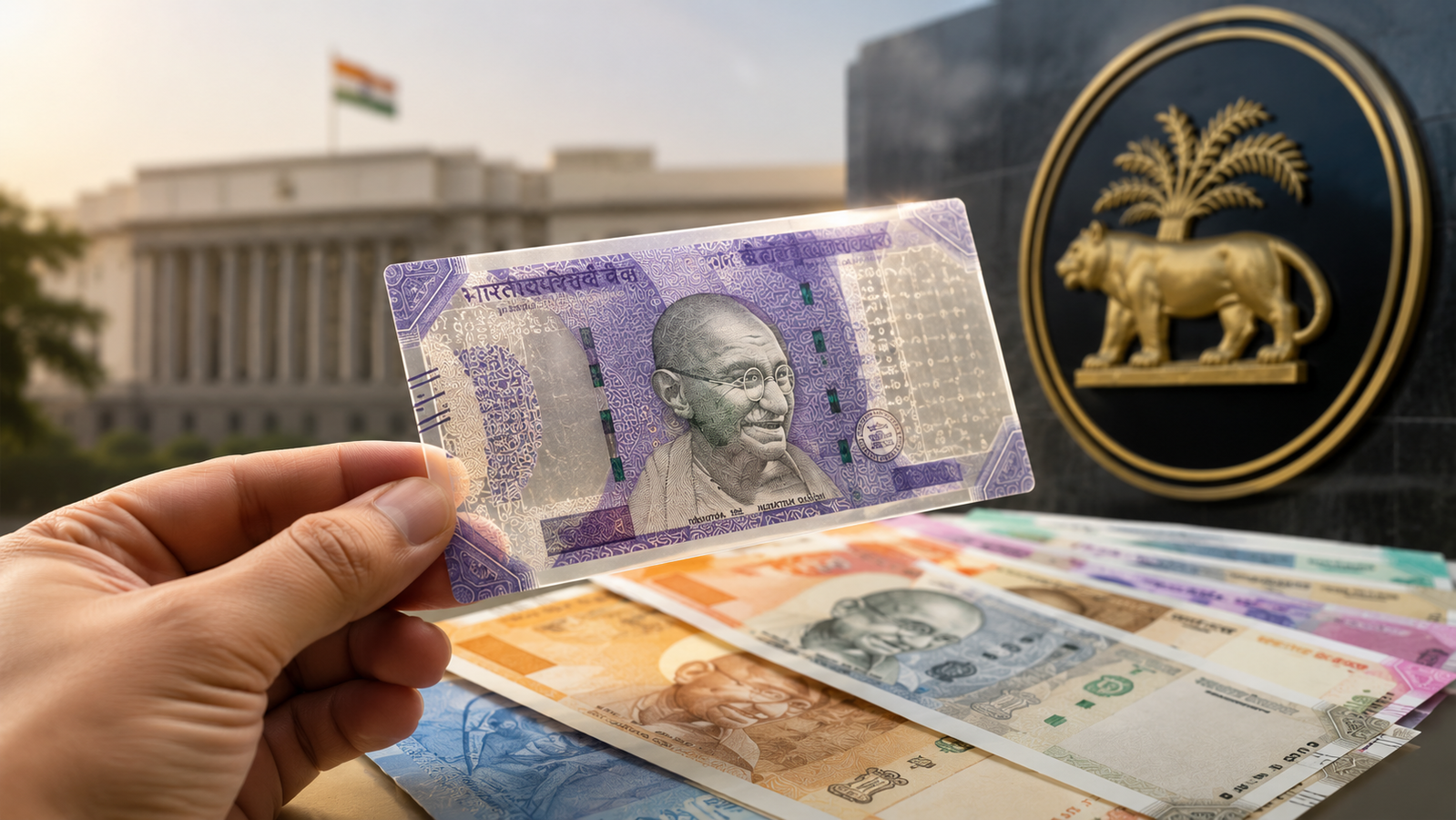
India could soon see plastic currency notes in circulation as the Reserve Bank of India (RBI) revisits a long-pending proposal to introduce polymer banknotes. The move comes at a time when the cost of printing paper currency is rising sharply and billions of damaged notes are being withdrawn from circulation every year.
According to a Business Standard report, the central bank is likely to launch a pilot project in the near future. Discussions on the proposal reportedly took place during the RBI's last two board meetings in Patna and Mumbai. Lower denomination notes such as ₹10 and ₹20 are expected to be the first candidates for testing because they tend to wear out faster due to frequent use.
What are polymer banknotes?
Polymer banknotes are printed on a flexible plastic material instead of the cotton-based paper traditionally used for currency. Although often described as plastic notes, they are soft, lightweight and can be folded much like conventional banknotes.
Also Read | India set to remain fastest-growing major economy with 6.9% growth outlook, says RBI
One of their biggest advantages is durability. Polymer notes are more resistant to moisture, dirt and tearing, allowing them to stay in circulation for a longer period. They also support advanced security features such as transparent windows, specialised inks and micro-optic holograms, making counterfeiting more difficult.
Because they last longer, central banks generally spend less money replacing worn-out notes, reducing long-term currency management costs.
Rising costs behind RBI's push
The RBI's renewed interest comes as currency printing expenses continue to climb. Expenditure on printing banknotes rose to ₹6,372.8 crore in the financial year ended March 2025, compared with ₹5,101.4 crore a year earlier, largely due to higher demand for cash.
At the same time, the volume of unusable currency being removed from circulation has increased. Around 23.8 billion soiled banknotes were withdrawn in FY25, up 12.3 per cent from the previous year. The ₹500 note accounted for the largest share of damaged notes, followed by ₹100 notes.
A decade-old proposal makes a comeback
India had earlier experimented with polymer currency in 2012 when the government approved field trials of one billion ₹10 polymer notes across Kochi, Mysore, Jaipur, Bhubaneswar and Shimla. The initiative was later dropped because of technological and operational challenges, including issues with ATM compatibility.
Also Read | Japan bans Indian mango imports after 20 years over pest-control concerns
According to the report, those hurdles have since been addressed, with newer systems capable of handling polymer notes more efficiently.
Used in more than 60 countries
Polymer banknotes are already in circulation in over 60 countries, including Australia, Canada, the United Kingdom, Singapore, Malaysia and New Zealand. Australia pioneered the technology in 1988, while many countries that adopted it later cited longer lifespan, stronger security features and lower replacement costs as key benefits.
For now, the RBI is expected to proceed cautiously with a pilot programme. Any wider rollout will depend on operational performance, public acceptance and the results of the initial trial.