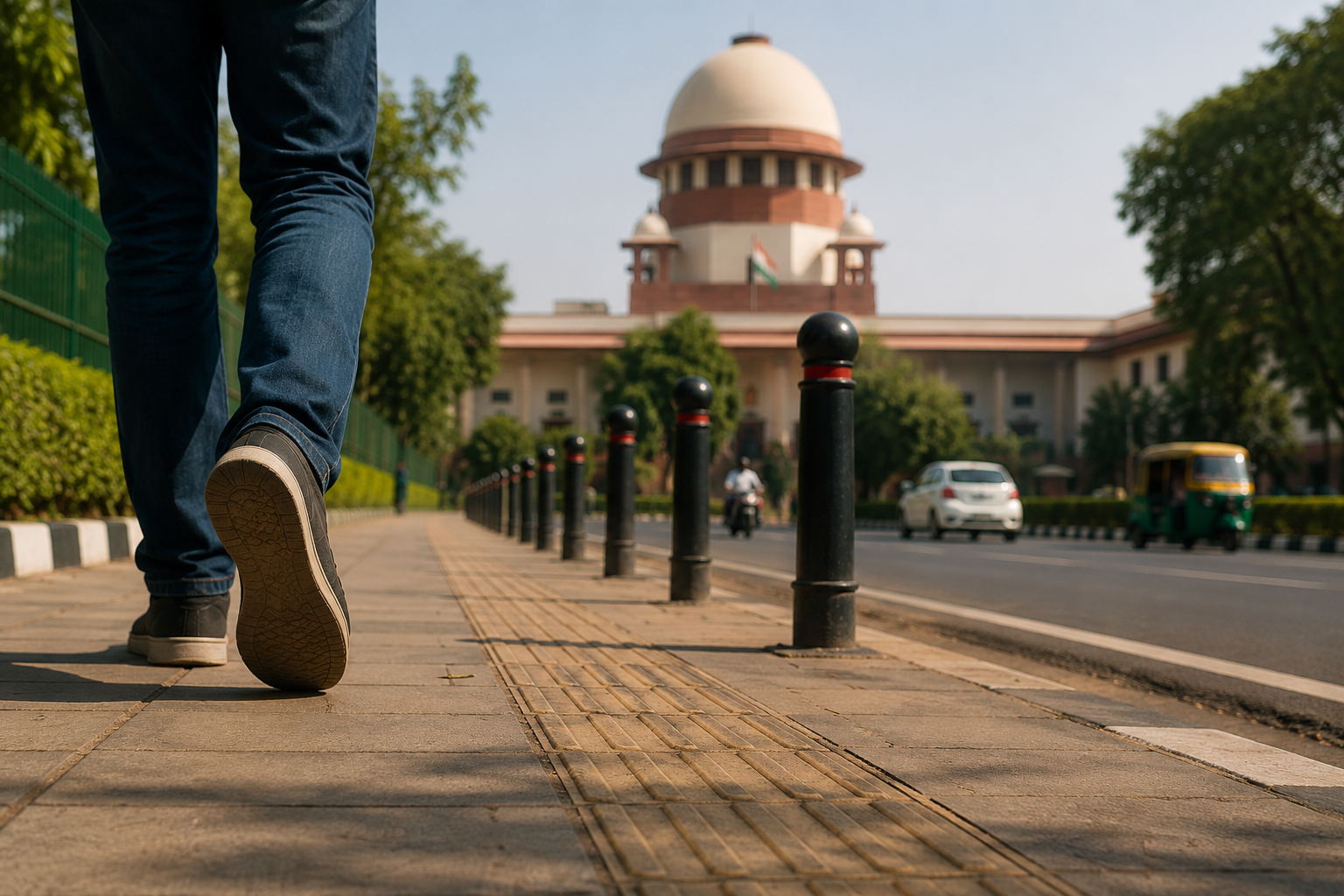
The Supreme Court on Friday held that the right to walk on secured, demarcated footpaths is a fundamental right, expanding constitutional protection for pedestrians in a motor accident case that arose from the death of a five-year-old boy.
A bench of Justices P S Narasimha and Atul S Chandurkar said the right to walk is integral to the Constitution’s guarantee of movement and life and that it must have priority over motorised vehicles.
The ruling came while the court heard an appeal linked to a fatal accident in which a tanker hit a child who was walking to school with his father.
Also Read | No relief for Telegram as court backs Centre's ban ahead of NEET retest
STORY | Right to walk on demarcated footpath is fundamental right: SC
— Press Trust of India (@PTI_News) June 19, 2026
The right to walk on a demarcated footpath is a fundamental right, the Supreme Court on Thursday ruled.
READ: https://t.co/eOC3mXXGp6 pic.twitter.com/oLos5agArU
On footpaths, rights and the road ahead
In its reasoning, the court said the absence of safe footpaths and the subordination of pedestrian space to motor traffic have been a “civilisational problem”.
It observed that human beings walked long before wheels were introduced and said public roads have increasingly been designed around vehicles rather than people. The bench said the right to walk flows from Article 19(1)(d), read with other freedoms and Article 21, and that this right extends to access to properly marked and maintained footpaths.
It also said the duty is not abstract: if a road exists, authorities must ensure that walkers have a safe and demarcated space alongside it.
A tragedy that shaped the ruling
The judgement was delivered in an appeal over compensation awarded after the child’s death. According to the court record, the man and his son were walking to school when a tanker struck the boy from behind, causing fatal injuries.
The Motor Accidents Claims Tribunal had awarded Rs 7.82 lakh with 6 per cent annual interest on May 30, 2016. The High Court later reduced the compensation to Rs 4.70 lakh after an insurer’s appeal.
The Supreme Court disagreed with that reduction, enhanced the compensation to Rs 1,144,628 and directed that the amount be paid within two months. The court also noted that there was no footpath or pedestrian crossing on the stretch where the accident occurred.
Sitting in your AC car, have you blamed a pedestrian for just walking on the side of the road?
— CiteCase 🇮🇳 (@CiteCase) June 19, 2026
Read this from today's #SupremeCourt judgment !
They have far better right than you on a motor vehicle ! https://t.co/QuWeRXnyCJ pic.twitter.com/kheXGBhkiR
Duties, remedies and a nudge to lawmakers
The bench said the right to walk on demarcated footpaths carries a corresponding duty on urban development authorities, municipal corporations, municipalities and panchayats to demarcate, construct, maintain and safeguard pedestrian infrastructure.
It added that violations of this right could open the door to constitutional and legal remedies, including restitution and compensation, independent of claims under the Motor Vehicles Act, 1988.
Calling for a clearer legal framework, the court urged the government to bring in legislation that formally recognises the right and fixes responsibility for enforcement.
It also directed the Registry to forward a copy of the judgement to the ministries of housing and urban affairs, rural development, and road transport and highways, as well as to the Law Commission, for consideration of the necessary legal structure.
Also Read | Can restaurants ban home-cooked food? Maharashtra consumer panel settles the debate
FAQs
Q1: What did the Supreme Court say about the right to walk on footpaths?
Ans: The Supreme Court held that the right to walk on safe, secured and demarcated footpaths is a fundamental right under the Constitution.
Q2: Why did the Supreme Court ask the government to frame a law on pedestrian rights?
Ans: The court said a clear legal framework is needed to define, protect and enforce the right of pedestrians to use safe footpaths.