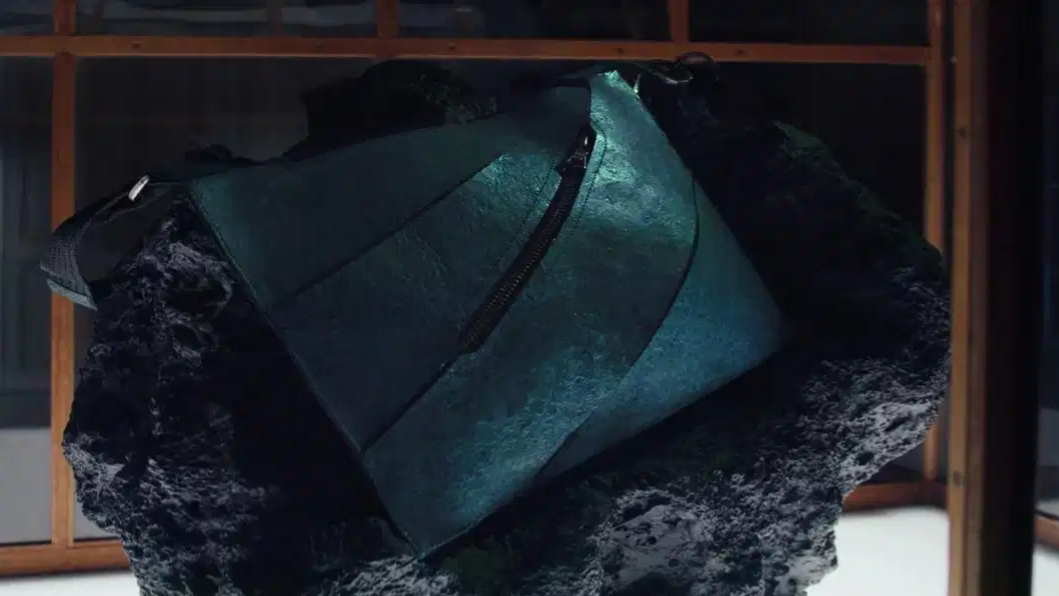
A handbag made from what creators describe as “dinosaur leather” has been unveiled, bringing together biotechnology and design in a project that is as controversial as it is eye-catching.
The teal-coloured bag, developed using lab-grown collagen linked to Tyrannosaurus rex, is currently on display at Art Zoo Museum. It will remain there until May 11 before heading to auction, where it is expected to fetch over $500,000.
The project is a collaboration between The Organoid Company, genomic engineering firm Organoid, and creative agency VML.
Also Read | Which is world's unhappiest country in 2026? New report reveals list
How ‘dinosaur leather’ was created
According to the team behind the project, ancient protein fragments recovered from dinosaur fossils were used to engineer collagen. These fragments were inserted into living cells, which then produced collagen that could be processed into a leather-like material.
As per a NDTV report, Thomas Mitchell, chief executive of The Organoid Company, acknowledged the complexity of the process. “There were a lot of technical challenges,” he said.
Che Connon, CEO of Lab-Grown Leather Ltd, which manufactured the material, said the innovation goes beyond sustainability. “It’s not just about a green alternative to leather, it’s a technological upgrade,” he said.
Scientists question ‘dinosaur’ claim
Not everyone is convinced by the label. Melanie During, a vertebrate palaeontologist at Vrije Universiteit Amsterdam, said that collagen found in dinosaur fossils survives only in fragmented form and cannot recreate actual dinosaur skin.
Also Read | THIS Indian city treats ice cream like a daily ritual: Here’s why
Thomas R. Holtz Jr., a palaeontologist at the University of Maryland, raised further doubts, noting that even if proteins were accurately replicated, they would not reproduce the complex fibre structure of real leather.
Mitchell, however, said criticism is part of the process. “When you do something new for the first time, there is always criticism. It’s the bedrock of scientific exploration,” he said.