Astronomical summer begins with the June 21 summer solstice, which arrives at 4:25 a.m. EDT and marks the Sun’s northernmost point in the Northern Hemisphere sky.
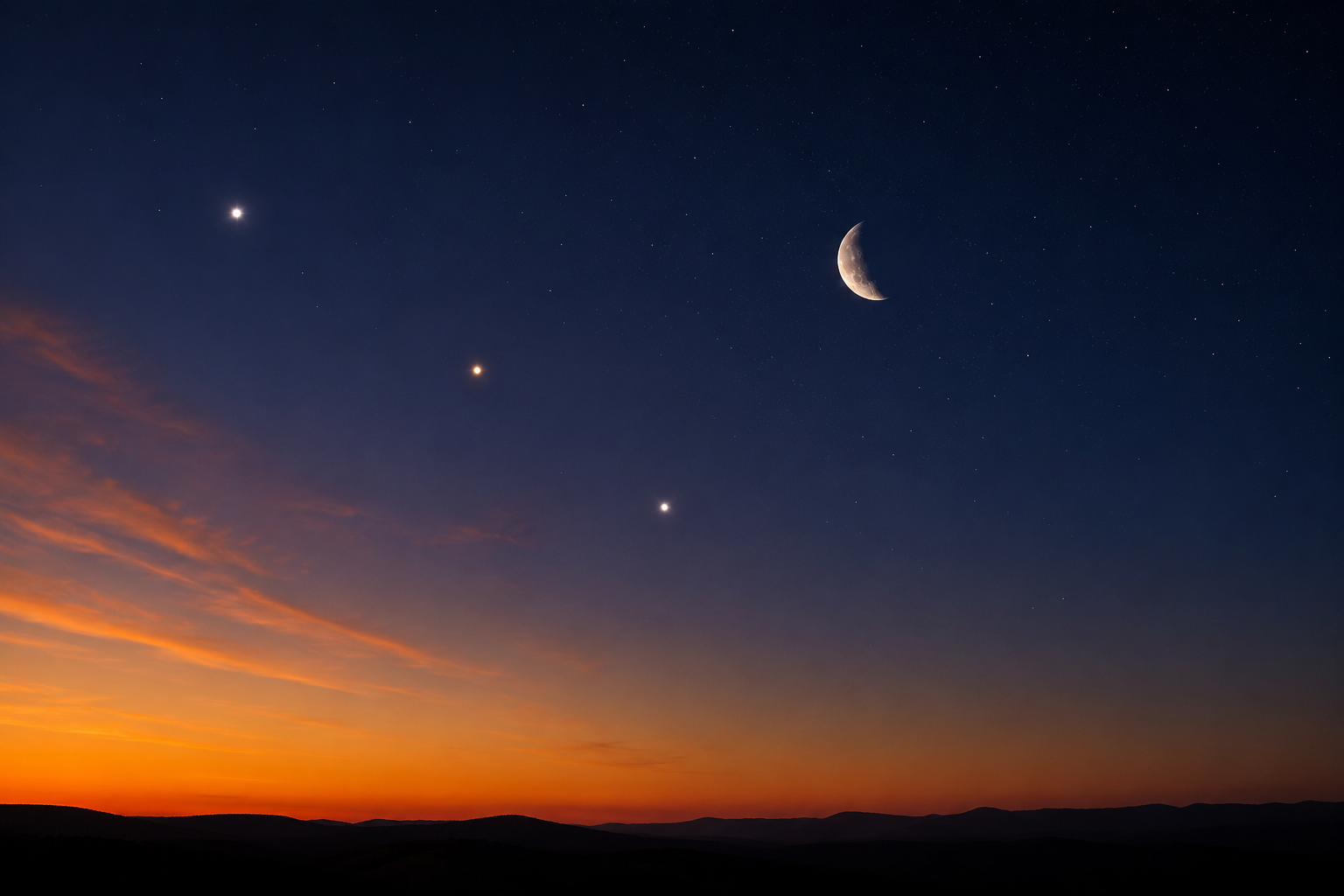
The date also brings the longest path of the Sun across the northern sky and the most hours of daylight for the hemisphere. It is a busy day overhead, with the First Quarter Moon occurring at 5:55 p.m. EDT and a conspicuous line of bright objects stretching across the western sky after sunset.
Also Read | William Shakespeare, Laurence Olivier and a line that refuses to grow old
A celestial rendezvous after dusk
The week opened with an especially photogenic pairing on June 19, when Venus sat just 45 arcminutes north of the Beehive Cluster in Cancer, while Jupiter and Mercury trail nearby in the dusk.
Astronomy says Venus is the brightest point of light in that part of the sky, with Mercury only about 5 degrees high and requiring a clear western horizon to spot. Binoculars should reveal the stars of M44 even before they are visible to the naked eye, making the Venus-Beehive conjunction one of the week’s easiest observational targets for evening skywatchers.
Smile! Tomorrow is the Northern Hemisphere’s summer solstice! 😎☀️
— NASA Solar System (@NASASolarSystem) June 20, 2026
This “sunny smile” is made of coronal holes — darker, cooler regions on the Sun where solar material escapes to space at incredible speeds. 🕳️
More on coronal holes in this episode of NASA’s Illuminate.👇 pic.twitter.com/aowugms4NS
An orderly affair above the horizon
On June 21, the evening sky arranges itself along the ecliptic, with Mercury in Gemini, then Jupiter, Venus, Regulus, the Moon and Spica forming a long, slanted chain after sunset.
That alignment reflects the shared plane of the solar system, which keeps the major planets and the Moon close to the same path across the sky. Regulus and Spica sit near the ecliptic as well, which is why the Moon repeatedly passes close to them. Astronomy says that same night the Moon is in Virgo and is waxing gibbous, at 52% illumination.
The deeper sky beckons
The rest of the week shifts the focus deeper into the sky. On June 22, observers with late-night access can look for the North America Nebula in Cygnus, while June 23 highlights Mercury’s pass south of Pollux and the Turtle Nebula in Hercules.
June 24 brings main-belt asteroid 21 Lutetia near a field star in Scorpius, June 25 turns telescopes toward Saturn and its moons, and June 26 closes with Mercury fading near Jupiter in the west, with Venus still visible above them.
For amateurs and casual observers alike, the week offers a rare mix of naked-eye sights and telescope targets under one seasonal milestone.
Also Read | What is the Turbulence Test? Here's how travel can reveal relationship compatibility
FAQs
Q1: When is the summer solstice in 2026?
Ans: The summer solstice occurs on June 21, 2026, marking the longest day of the year in the Northern Hemisphere.
Q2: Which planets can be seen in the sky during the week of June 19–26, 2026?
Ans: Skywatchers can spot Venus, Jupiter, Mercury and Saturn at different times during the week.