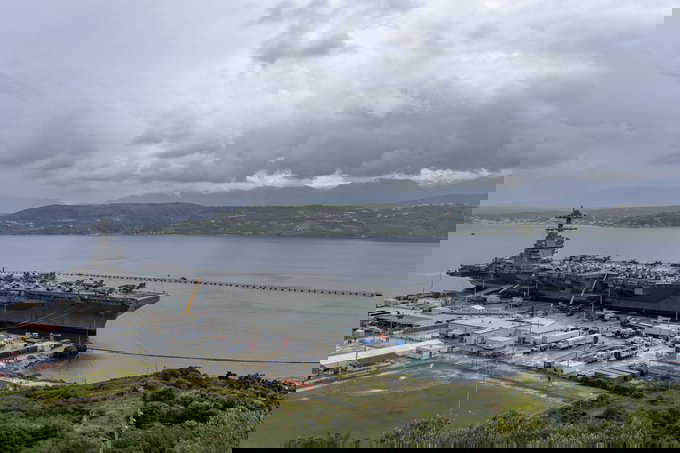
The U.S. Navy says unmanned surface vessels are no longer experimental. In a January speech at the Surface Navy Association symposium, Vice Adm. Brendan McLane said the Surface Navy had grown from owning about four small USVs last year to “hundreds” this year, with medium USVs due to deploy with a carrier strike group and containerized payloads forming part of the concept.
The remarks point to a force structure in which autonomous platforms are being treated as operational assets rather than niche trials.
A squadron dedicated to the future
That transition is also visible in the Navy’s organization. USVRON-1 describes itself as a squadron dedicated to the future of unmanned systems and autonomy in the Navy, while USVRON-3 saw commanders of its unmanned surface vessel divisions assume command in January 2026.
In the same symposium speech, McLane said the Navy is integrating unmanned systems as warfighting assets and using them to extend reach, increase lethality, and reduce risk to the force.
Progression with proof of concept
The shift has been building for years. DARPA’s ACTUV program, which produced the Sea Hunter prototype, was transferred to the Office of Naval Research in 2018 after demonstrating a highly autonomous unmanned ship designed to travel thousands of kilometers over open seas for months without a crew. DARPA said the concept was meant to track quiet diesel-electric submarines and pointed to a future fleet in which manned warships and large unmanned vessels would complement each other.
Also Read | Unusual family business shocks: Chinese woman earns Rs 1.35 crore from snakes
First partner-ship launch of Lightfish signals wider unmanned fleet push
More recently, U.S. 6th Fleet launched the Lightfish unmanned surface vessel from a partner nation’s ship during Cutlass Express 2026 off the coast of the Indian Ocean, marking the first time the system was deployed from a partner surface vessel.
The Navy said Task Force 66 already operates 22 USVs and is using joint exercises to test robotic and autonomous systems in open-ocean conditions with limited connectivity, signaling a broader push to scale unmanned maritime operations across theaters.
What a “robot navy” means for modern war at sea
A “robot navy” is a fleet that uses unmanned ships, submarines, and drones alongside regular warships. These systems can be remote-controlled or autonomous.
They help navies patrol longer, scout risky areas, detect mines, and track enemy movements without putting sailors in danger. In war, that means faster decisions, wider reach, and lower risk. Major players include the US, UK, China, Australia, Israel, and India, all investing in robotic vessels and AI-driven maritime systems.