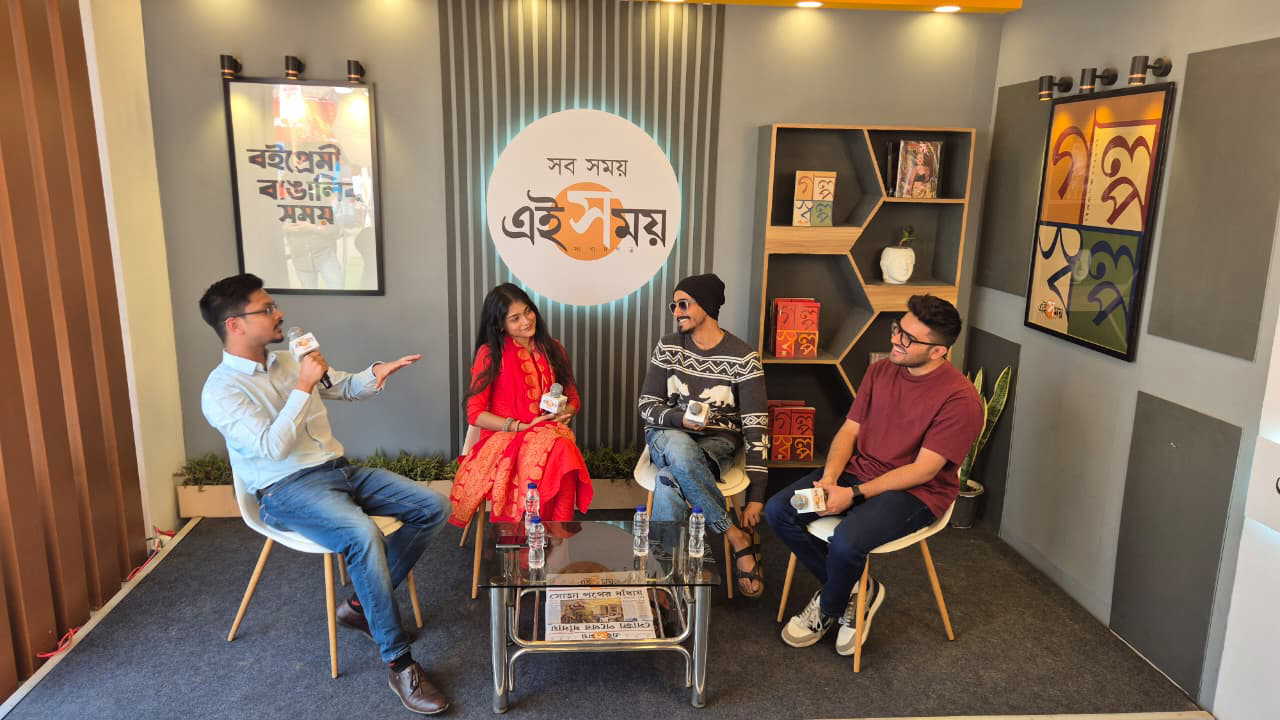
News Ei Samay hosted a thought-provoking discussion for the new-age Gen Z audience, digital natives, and netizens navigating an increasingly algorithm-driven world at the Ei Samay book fair stall (stall number 198). The session centred on the timely and layered theme, “AI- alpha or toxic?”,to discuss the growing impact of AI indigital platforms, algorithms, and security on the public sphere.
The panel featured Priyam Ghose, Anindya Sengupta, and Anusha Viswanathan to bring distinct generational and professional perspectives to the conversation.
AI, originality, and the creator’s dilemma
Opening the discussion on how AI fits into everyday creative conversations, Priyam Ghose described AI as a “Benre Paaka” (intellectually mature, used sarcastically), explaining, “ AI does help me a lot in my content creation but it also has consequences in the sense that people just rely on AI for their content creation, right? As a result, originality comes in, and when we used to make content in 2019, we used to actually give time to think, like ideation, curation and everything. Right now, you just put a prompt and you know what to say in front of the camera and you don't even kind of fact-check or anything like that. So, yeah, it has consequences.”
Expanding on how algorithms have altered creative freedom, Priyam added, “Earlier, I had the freedom to make content as and when I wanted. As a full-time professional content creator, it was fine to make one video a week. Now, doing one video a week doesn’t help, neither my career nor my growth, because the algorithm and AI push you to make at least four reels a day. Even if I don’t have that many ideas, I still have to put out content to keep up with competitors and trends. As a result, people are getting exhausted, originality is dropping, and we’re not seeing the content people actually want.”
Old-school learning, algorithms, and control
Speaking on AI’s role in media and print, Anindya Sengupta made it clear that he does not see AI as a replacement for human intelligence. He said, "I have not gone through formal structures of education. I have never been academically good, even when I was in school. However, I do have proper subscriptions to Gemini Pro, Berkeley SE Pro, and Jackety Plus, and that helps me access information. I have YouTube Premium and several other subscriptions.”
He further explained how access alone is not the issue, “Getting access to information now depends solely on me-how I use that information and how the algorithm works. I think I can control and utilise my algorithm. I will take advantage of it because I accept cookies, and they give me certain benefits. I already have an algorithm set. I know what my social media feed is.”
On the importance of traditional research methods, Anindya added, “So that it does not, it cannot map me into a certain area. But then again, I do come across a lot of younger people, of your age and even younger, on YouTube and across various social platforms and digital platforms, who are crying out loud to learn to research the old way as well. Because that is going to teach you how to take better advantage of this tool. At the end of the day, it is going to be a tool.”
ALSO READ | Do publishers still reject Pracheta Gupta? Author and Ullas Mallick's honest chat at Kolkata Book Fair 2026
Later, discussing responsible AI usage, he noted, “It is how you choose to. And if you're asking AI to, okay, write the blurb, if you've written a story, and you've asked the AI to just write a blurb for you for pitching and presentation, you understand that. You can present it to ChatGPT, are there any spelling errors, just like we would do with Microsoft Word. But if you're thinking for it to actually do the thing which a human brain can only do, it is not going to be, you are going to be pushed to that.”
Boundaries, culture shifts, and protecting creativity
Anusha Viswanathan brought in a more cautious, reflective stance on dependency. She shared, “I, if I have to research on something, I will read it, read about it, or, you know, like read essays, like, you know, how I've done in college. So, I'm not somebody who's, I don't even make, you know, sometimes I've tried, you know, using very basic AI, because I also don't want to have, to give subscriptions to, like, 500 AIs. Like, I want to be able to figure it out on my own, if I can.”
Addressing privacy and personal boundaries, she said, “When they’re hearing about your patterns and relationships, how you’re dealing with people, they are researching on us. What we should be doing is our own set of research, figuring out what the rules are. I’m not somebody who’s not open to AI. I’m not saying AI is bad. It’s like going into a new relationship—don’t go all in. Don’t get distracted. Make sure you have boundaries. I think this is something this generation lacks, especially in terms of social media. Everyone should be brought up with the idea of respecting other people.”
On personal expression and platforms, she shared, “I used to enjoy Instagram, when I could just do this-even a little bit of songs. I’m someone who loves to express through my taste in music, and I still do that. But now I choose from trending songs because my job requires more followers. Unfortunately, that’s what it is now. If I weren’t part of this industry, I wouldn’t care. I still don’t care, as of now, unfortunately.”
ALSO READ | OlyPub issues apology after waiter’s arrest over alleged wrong meat service
Discussing recent trends around Studio Ghibli-style content, Anusha remarked, “Now, everybody jumped on that trend, I didn't, but that is only because I am a Studio Ghibli fan and I love watching his work and I know that everything that he does is hand-sketched and he takes years to make every frame perfect… imagine if you came up with an IP, which somebody that, someone is stealing.”
Anusha concluded with concerns over legal safeguards, saying, “And there is no legislation to protect us, that is my problem… I think to protect everyone's IP, we have to now protect our face and our voice.”
In the end, the discussion highlighted a shared concern across generations: AI is a powerful tool, but its value depends entirely on how thoughtfully it is used.