"When I send my writing, it still often gets returned!"-The listeners were stunned to hear these words from the mouth of writer Pracheta Gupta.
Pracheta Gupta: a name that instantly evokes the world of children’s literature, colourful imagination and stories that shaped the adolescence of countless Bengalis; publishers return his manuscripts?
Though the audience was surprised, for Pracheta, having his writing returned is actually positive. In his opinion, as long as manuscripts keep coming back, we must understand that literature is fine. As long as editors think your writing isn't good enough, our literature will remain healthy. As long as readers return books, our literature will stay healthy. If they don't like it, they'll certainly say so. Only then will the real message emerge when they do like something. Therefore, getting manuscripts returned is not shameful at all.
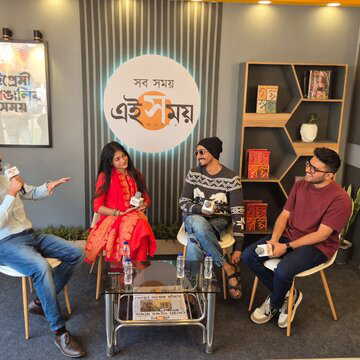
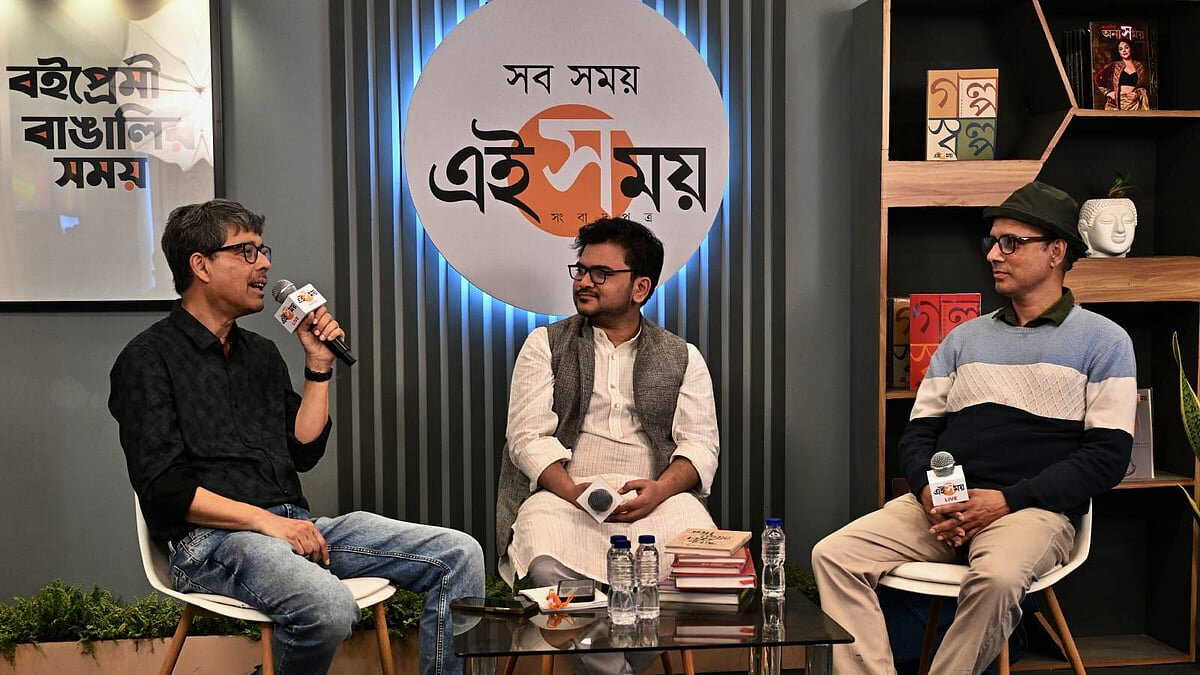
Beside him was Ullas Mallick. Another renowned storyteller of the present time. Though like a younger brother to Pracheta, they are friends. Ullas also said jokingly with laughter, "Yes, my writing gets returned too. Whatever gets rejected more by Pracheta comes to me. I have an online magazine. He sends them there for publication. He's even offered money for this!"
On Monday evening, such an entertaining chat and discussion with these two prominent writers took place at the Ei Samay pavilion at the 49th International Kolkata Book Fair. The Ei Samay stall is just a short walk from gate number four of the fairgrounds at Central Park in Salt Lake. This year, too, Pracheta has a new book out. Ullas has also published a book. But long ago, Pracheta had decided that until his book comes out, he wouldn't go to the book fair!
Pracheta laughed when this childhood memory came up. He said, "I really thought so many people's books are published, and I don't have any book! I won't enter the book fair anymore. Who exactly was this anger directed at? While thinking about this, the next book fair would arrive. More than anger or resentment, it was actually a stubbornness that I too would write a book someday. Back then I didn't know that just writing a book doesn't actually make it a book. Just as writing something doesn't make it literature. Similarly, stuffing pages between two covers and saying let's go to the book fair doesn't work. Anyway, I've managed to write something. I've been coming to the book fair for many years now."
ALSO READ | Padma Shri awardee Prosenjit Chatterjee’s heartfelt welcome steals the spotlight at Book Fair
But is there any difference between the book fair of those days and today's book fair? Ullas says, "The crowd has increased compared to before. I'm getting a bit lost in the cacophony. Sounds are bursting out from various stalls. But the warmth is still there as before."
Following the thread of the rejection story, Pracheta's new book "Sajgojer Baksho" also came up in the discussion. In the introduction to this book, he wrote, "Many say writing too much is not good at all. Writing less makes the writing better. I had experimented with this. Once, in the greed for good writing, I didn't write anything for six straight months. What I wrote in the seventh month was not only rejected by the editor as unsuitable, but he also wrote a line saying, 'It's obvious you haven't been in the writing practice for a long time. Practice for about six months and then send. Winter has set in. Take care.'"
Is this a true incident? Pracheta's immediate response: "Everything is true. What I say, what I think, what I write—all true." Following this statement came the next question: is a break really necessary? Ullas's humorous answer was that he needs breaks due to laziness. In his words, "This depends on the writer. A couple of times I felt a break was necessary. Actually, I feel very bad about writing. I don't know if it's necessary or not. I feel like it would be better to stay away from writing. Then again, I have to write under pressure from editors. I take breaks naturally. Not from any urgency. Due to laziness."
Pracheta also believes, "Having breaks is important. I write very little anyway. Now I see many people writing four-five novels a year. I like it. They can do it. But I can't. I can't write more than one novel a year. I can't write too many stories either. Maybe ten a year. One a month. Breaks are necessary. Writers need to get stuck sometimes. Writers also need to restrain themselves."
He prefers writing stories over novels. In his words: "Stories are much more intense to me. Much sharper. Much more joyful and much more painful at the same time. Whatever comes, comes like the point of a needle. The joy when raindrops fall on the body cannot be compared with the joy of diving into a pond. The two are not the same. I've written in many places that when I sit down to write a story, I feel like I'm playing chess with the story."
And poetry? When someone expresses appreciation by saying "just like poetry," does Pracheta like this praise? The storyteller's answer: "Beautiful like poetry—this phrase has been in circulation for a long time. It has now become a cliché. I don't write poetry though. Never have, not even for a day. But when someone says this, I feel proud. Saying 'like poetry' doesn't diminish prose. We say 'like poetry' to convey the beauty of poetry. This shouldn't be taken literally. It should be understood semantically."
However, Ullas believes there's also a kind of deception in such clichés. In his words, "I have an experience. There's a group of thoughtful readers or viewers who understand the essence of poetry, so they say 'like poetry.' But in Bengali literature, several phrases have become clichés. If I watch a movie and understand nothing but still say 'like poetry,' then all my sins are forgiven! There's also some deception in this. Maybe they understood nothing at all, yet said, 'Something stirred inside me,' 'Someone seemed to push me' or 'I'm sitting stunned.'"
Just as Pracheta's stories and novels have a touch of 'absurdity,' Ullas's writing contains humour. But if his mind is irritated, angry, or fragile for some reason, or if laughter is nowhere to be found, can humorous stories still be written? The storyteller replied, "I always prefer to stay in a jovial mood. So that doesn't become a problem. Even if something sad happens sometimes, I have to push it away from my mind. And this is also a matter of habit. Writing for a long time makes this happen."
Agreeing, Pracheta also said, "If there's humour or wit in writing, there's another dimension within it. Often there's subtle pain too. There's harsh social injustice. There's torture, humiliation. There's a protest. This is why Ullas is such a great writer. Because in his writing, the humour, comedy, sarcasm, and satire have much pain, protest, deception, and love hidden beneath. That's why it becomes literary. There's no vulgarity there. There's no reason to think that just because something is funny, it will be good. There can be crudeness in laughter. But there can also be laughter of refined sensibility. Ullas is one of the most witty writers of this era." Ullas completed Prachet's sentence. He said, "Before the laughter ends, a couple of tears fall from our eyes!"