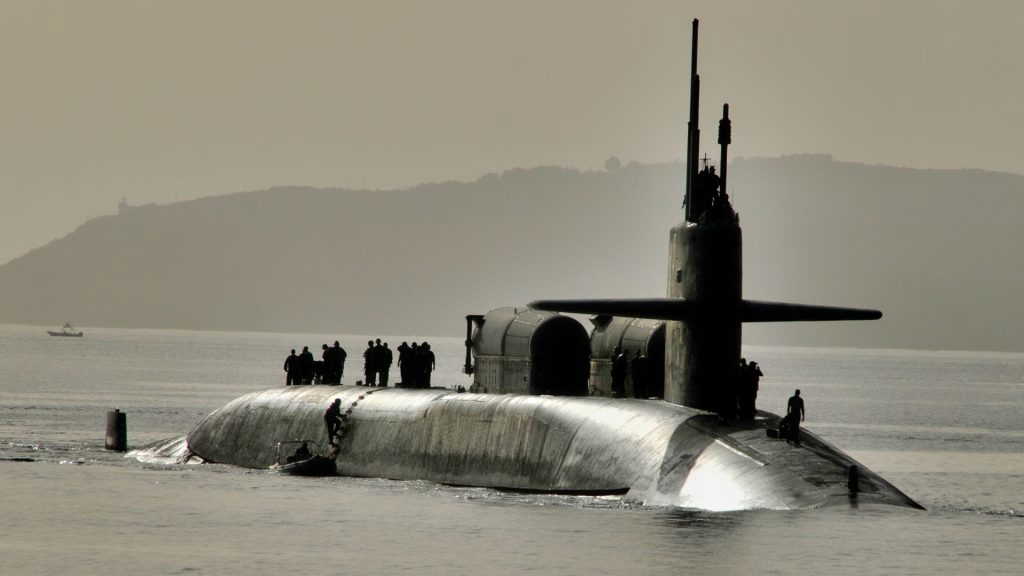
Over the next few years, the US Navy will retire its four Ohio-class guided-missile submarines, the most powerful conventional strike assets ever deployed underwater.
Now, Jack Buckby, a New York-based defence analyst and British researcher, warns that this could be a looming “magazine depth” crisis for the Navy. He noted that the transition to newer Virginia-class submarines, even those equipped with the Virginia Payload Module, could result in a “75% reduction in strike capacity per hull” compared with the retiring Ohio-class SSGNs, per the National Security Journal.
The current Operation Epic Fury in Iran, as of March 9, 2026, has highlighted the importance of the Tomahawk land-attack cruise missile (TLAM), with the Navy running out of them to destroy IRGC infrastructure.
What is this Ohio-class SSGN?
The Ohio-class SSGNs are uniquely capable missile carriers. Each submarine can launch up to 154 Tomahawk land-attack cruise missiles, giving the four-submarine fleet the ability to deploy more than 600 precision-guided strike weapons from stealthy underwater positions.
Originally built during the Cold War as nuclear ballistic-missile submarines, the vessels were later repurposed after arms-reduction agreements in the 1990s reduced the need for such a large nuclear deterrent fleet.
Instead of retiring them outright, the Navy converted four boats, USS Ohio, USS Michigan, USS Florida, and USS Georgia, into guided-missile submarines between 2002 and 2008.
The redesign replaced Trident nuclear missile systems with vertical launch tubes capable of holding clusters of Tomahawk cruise missiles. Because the original missile tubes were built for large ballistic missiles, they could accommodate multiple cruise missiles per tube.
The vessels can also deploy special operations forces and support intelligence missions. However, despite their capabilities, the submarines are now approaching the end of their service lives. Built in the early 1980s, many of their components, including reactors and structural systems, are nearing the limits of safe operation.
The Navy plans to begin retiring the boats this year, with all four expected to leave service by 2028.
Replacement submarines are already being introduced. The Virginia-class attack submarines equipped with the Virginia Payload Module (VPM) are designed to partially fill the gap. But analysts say they cannot fully replicate the firepower of the Ohio SSGNs.
ALSO READ| What is ‘Mother of Satan'? Cops seize lethal IED thrown during NYC protest, arrest two
Notably, a Virginia-class submarine with the payload module can carry roughly 40 Tomahawk missiles, far fewer than the 154 carried by each Ohio-class guided-missile submarine. It would take several Virginia-class submarines operating together to deliver the same volume of missile strikes as a single Ohio SSGN.
What are Tomahawk missiles?
The Tomahawk Land Attack Missile is designed to hit targets deep inside enemy territory with high precision. During the early phases of the current conflict with Iran, US ships and submarines reportedly launched multiple Tomahawk strikes against Iranian military infrastructure, targeting air-defense systems, missile sites and command facilities.
These weapons allow the United States to strike from long distances without risking pilots or exposing surface warships to enemy defences.