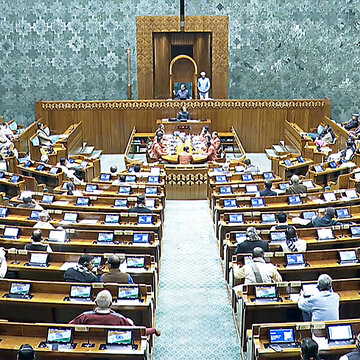
The Union government on Monday informed the Lok Sabha that Operation Deep Manifest, an enforcement drive aimed at identifying and intercepting Pakistan-origin goods entering India through indirect routes, is currently underway. The information has been revealed in the Lok Sabha by the Minister of State for Finance, Pankaj Chaudhary, in the form of a written reply.
Responding to a question from Kaziranga MP Kamakhya Prasad Tasa, Chaudhary said the main objective of the operation is to detect and detain goods that originate from Pakistan and enter the country through third countries.
Operation targets indirect import routes
According to the minister, the operation is aimed at detecting goods that could be exported from Pakistan and then enter the country through other countries.
“The primary objective of the said Operation is to identify and seize consignments originating from Pakistan and transhipment via third countries to India,” Chaudhary said in his reply.
Also Read | India mulls naval escort for ships stranded near Strait of Hormuz amid Iran threats
He added that the Directorate of Revenue Intelligence (DRI) has already identified several such cases. As many as 12 cases involving the import of goods originating from Pakistan through the United Arab Emirates have been registered as of January this year, with the goods being worth ₹1,784 lakh.
The move is part of a larger initiative by law enforcement agencies to curb the indirect movement of goods from Pakistan into Indian markets.
Tourism relief measures after Pahalgam attack
In yet another Lok Sabha response, Union Minister for Tourism Gajendra Singh Shekhawat outlined measures for the tourism industry in Leh and Kargil in Ladakh in the aftermath of the attack in Pahalgam in September 2025.
Data presented in the reply indicated a sharp fall in tourist arrivals after the incident.
Kargil recorded a 70.9% drop in domestic tourists between 2024 and 2025, with numbers falling from 3,20,432 to 93,389. Foreign tourists in the Kargil district fell by 27.12% from 2024 to 2025.
In Leh, while domestic tourists fell by 27.3%, foreign tourists fell by 16.80% from 2024 to 2025.
Loan relief and rehabilitation plan
In a bid to help local businesses in Ladakh in this difficult time, the finance department in Ladakh has allowed banks in the region to offer relief measures as per the RBI Relief Measures for Banks in Areas Affected by Natural Calamities announced in 2018, as directed in September 2025.
Also Read | Delhi Assembly budget session likely to begin from March 16
Following this, State Bank of India, Punjab National Bank and J&K Bank introduced rehabilitation plans for borrowers, including those linked to the tourism sector.
These measures include extension of repayment periods for existing loans, moratorium options, conversion of accrued interest during moratorium into Funded Interest Term Loans (FITL), and additional working capital credit of up to 15% of existing fund-based limits.
Homestay push and tribal development schemes
The Minister also highlighted the initiatives taken by the Government to boost tourism in the area.
One such initiative taken by the Government is the Pradhan Mantri Janjatiya Unnat Gram Abhiyan scheme. This scheme aims at improving the socioeconomic conditions of the tribal population.
Also Read | Delhi govt strengthens Yamuna banks between ITO and Sarai Kale Khan to improve flood management
The government is also promoting the development of 1,000 homestays in Ladakh. “The States and Union Territories, including Ladakh, can avail assistance of a maximum of Rs. 5 Crore for implementing 5-10 homestays per village in a village cluster of 5-6 villages, subject to eligibility as per the Guidelines issued on 01.07.2025”, he said further.
In addition, homestay operators can access collateral-free institutional credit through Mudra loans, announced in the Union Budget 2025–26, to support tourism-related entrepreneurship.