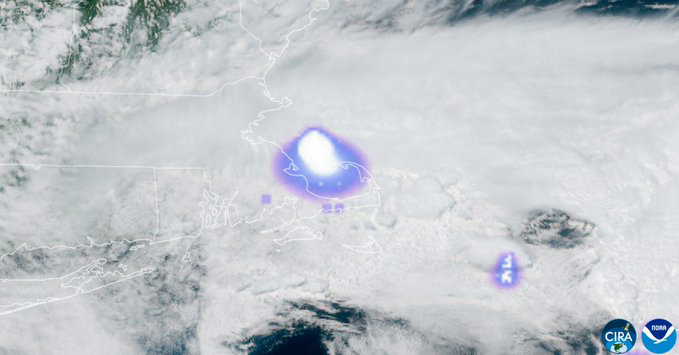
A sudden loud boom reported across parts of the northeastern United States, including Boston and Rhode Island, has been linked to a possible meteor after satellite data detected an atmospheric flash at the same time as the disturbance.
The sound led to immediate confusion among residents, many of whom initially wondered whether they had heard an earthquake or an industrial blast, according to Hindustan Times.
Also Read | Trump demands Iran give up nuclear ambitions as ceasefire talks continue
🇺🇸 Not officially confirmed yet, but the satellite data is pretty compelling
— Mario Nawfal (@MarioNawfal) May 30, 2026
GOES-19 picked up an anomalous flash east of Boston consistent with bolide reentry, with no storm activity anywhere near it.
Meteorologists are calling it the likely source of the boom heard across… https://t.co/gdwWTIcW7p
Quite the riddle across New England
The reports spread quickly on social media as people tried to identify the source of the noise.
Residents described a powerful boom that appeared to shake buildings, with the sound strong enough to prompt concern across the region. Some people compared it to a sonic boom or a distant explosion, while others feared seismic activity.
EXPLOSION HEARD IN BOSTON (VIDEO)
— Russian Market (@runews) May 30, 2026
Buildings shook from the North Shore to the Cape. No quake, no storm.
Early consensus: meteor (bolide) sonic boom. GOES-19 satellite caught a big flash with zero thunderstorms. pic.twitter.com/tc9aJzK49n
One by one, the theories fall away
That possibility, however, was ruled out.
The United States Geological Survey did not record any earthquake in the region at the time of the incident, despite widespread reports of shaking. Authorities also found no evidence of fire, explosion or any other ground-based event that could explain the sound.
The strongest clue came from GOES-19, which detected a strong atmospheric flash that coincided with the timing of the boom.
The signal pointed to an incoming meteor burning up and exploding in Earth’s upper atmosphere.
Such events can create a bright flash followed by a sonic boom that travels over long distances, matching the sequence described by people on the ground.
Also Read | Japan's population marks steepest decline since census records began in 1920
The heavens offer their explanation
The flash did not align with any active thunderstorm systems, further reducing the likelihood of a weather-related explanation.
Based on the available evidence, the boom was most likely caused by a meteor entering Earth’s atmosphere, though a final official classification was still pending.
No physical damage or secondary effects had been confirmed on the ground.