
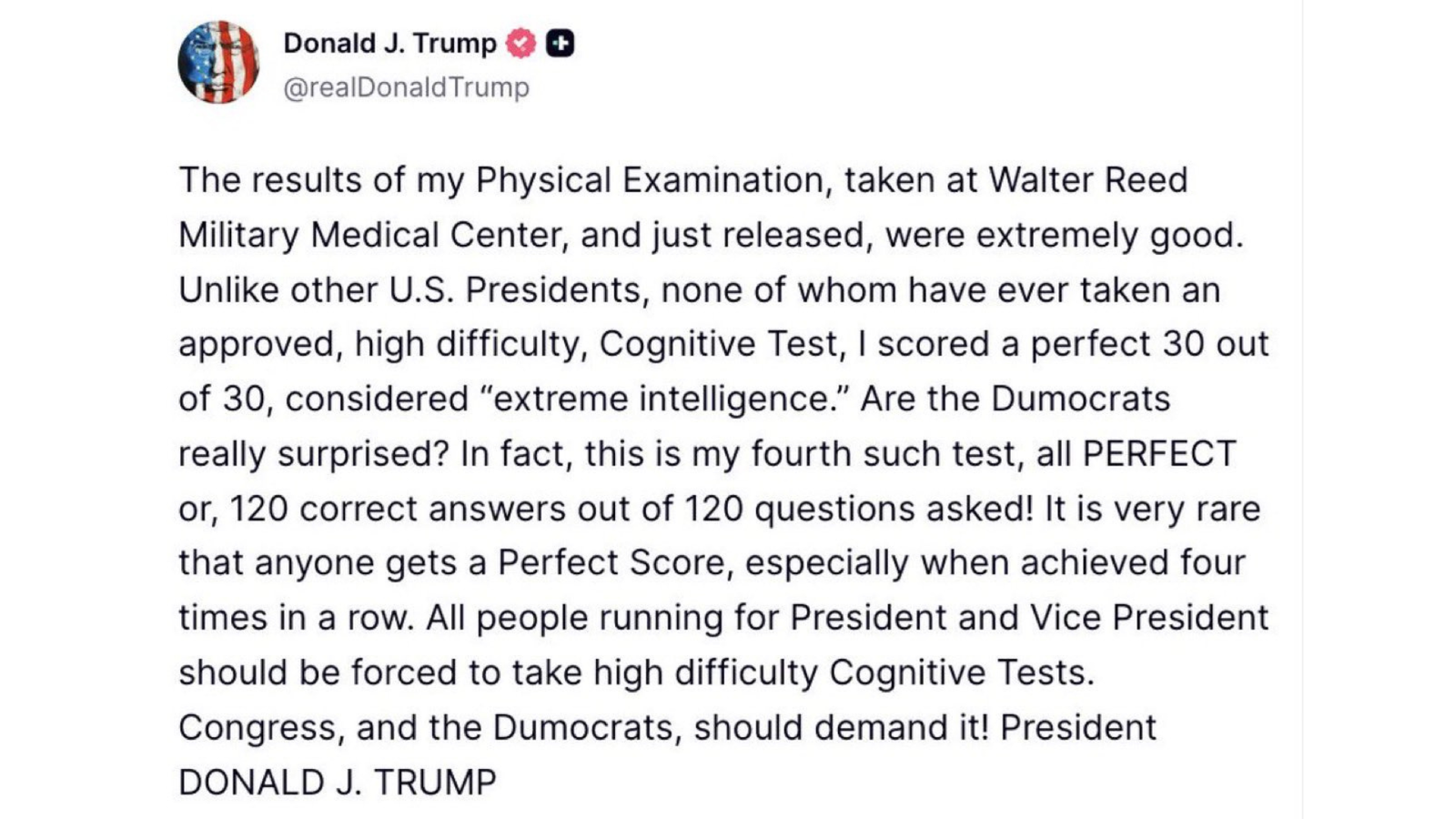
As US President Donald Trump nears his 80th birthday this month, his latest medical examination has once again brought attention to cognitive health and aging leaders. During a recent physical evaluation at Walter Reed National Military Medical Center on May 26, Trump reportedly completed a cognitive screening test for the fourth time and achieved a perfect score of 30 out of 30.
According to reports, Trump described the result as proof of “extreme intelligence". The assessment administered during the examination was the Montreal Cognitive Assessment (MoCA), a widely used screening tool designed to detect signs of mild cognitive impairment and early dementia.
What is the MoCA test?
The MoCA was developed in the early 2000s by Canadian neurologist Dr Ziad Nasreddine. It is a short, 10-minute test that evaluates several areas of cognitive functioning, including memory, attention, language, concentration, executive function, and orientation.
Unlike IQ tests, the MoCA is not designed to measure intelligence. Instead, it helps doctors identify early cognitive changes that may require further evaluation.
The assessment includes a series of tasks such as drawing a clock showing a specific time, copying a cube, identifying animals, recalling words after a delay, repeating number sequences, solving basic abstraction exercises and correctly identifying the date and location.
A score of 26 or higher is generally considered normal, while 30 is the highest possible score.
What Trump’s health report said
In a statement released after the examination, White House physician Dr Sean Barbabella said Trump’s result “was within normal limits" and reflected “normal mental status".
The report described the president’s overall condition as “excellent", citing strong neurological, cardiac and pulmonary function. According to the doctor, Trump remains “fully fit" to carry out the responsibilities of Commander-in-Chief.
However, the report also noted that Trump currently weighs 238 pounds, up from 224 pounds last year. Doctors advised him to focus on diet, physical activity and continued weight management. The report additionally mentioned mild improvement in lower leg swelling related to chronic venous insufficiency, a condition commonly seen in older adults.
Why experts say one test is not enough
Medical experts have repeatedly noted that while the MoCA is effective for screening cognitive decline, a single perfect score should not be viewed as a complete measure of long-term mental resilience.
The assessment provides a snapshot of cognitive functioning at a particular moment. Doctors often stress that long-term cognitive health is also closely linked to physical fitness, cardiovascular health and lifestyle habits, especially in older adults.