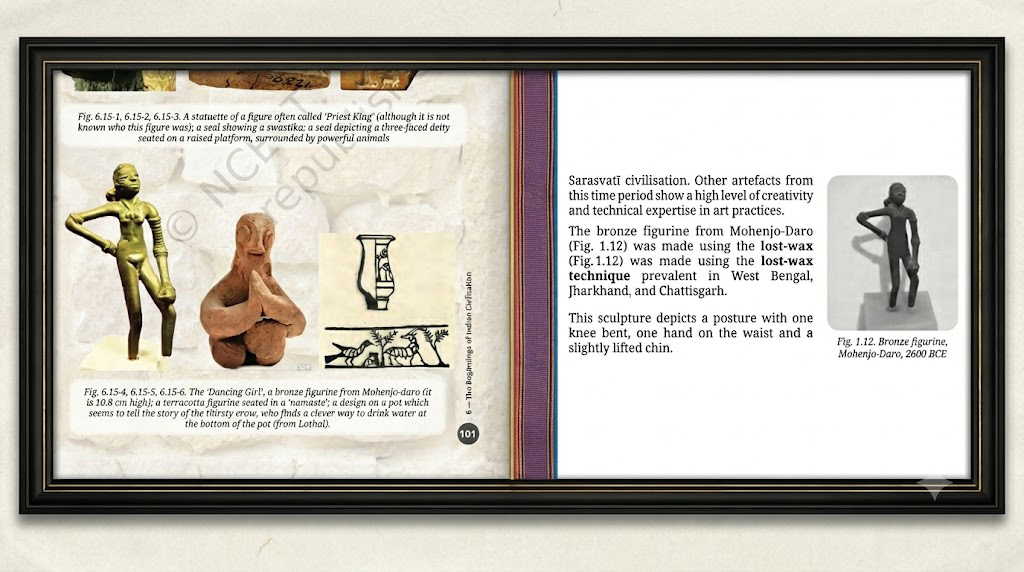
India's iconic Dancing Girl of Mohenjo-daro has become the centre of a fresh debate after NCERT's newly introduced Class 9 arts textbook presented the 4,500-year-old bronze figurine in an altered form, with its traditionally bare torso visually covered.
The image, featured in the opening chapter titled History of Arts, has raised questions about whether educational material should modify historical artefacts to suit modern notions of age appropriateness.
The controversy has also reopened larger discussions around historical accuracy, artistic integrity and India's stated goal of decolonising education.
A subtle alteration that sparked a major debate
The Dancing Girl is among the most recognisable symbols of the Indus Valley Civilisation. Discovered at Mohenjo-daro in present-day Pakistan, the bronze statuette stands just 10.5 centimetres tall and is celebrated for its naturalistic design, confident posture and intricate jewellery.
In the new textbook, however, the figure appears darker and portions of its torso have been shaded or visually covered compared to the original artefact.
Observers quickly pointed out that NCERT's own Class 6 Social Science textbook had earlier reproduced the sculpture in a form much closer to the original.
The altered depiction has prompted concerns among historians, educators and social media users, many of whom argue that changing an archaeological object amounts to rewriting history rather than simplifying it for younger audiences.
Also Read | UPSC Civil Services Prelims 2026 results expected soon: Key details candidates should know
Michel Danino questions 'Victorian morality'
According to The Times of India, historian Michel Danino, who headed the textbook development committee for NCERT's new Class 6 Social Science books, criticised the rationale behind altering the image.
Danino said he was previously informed that the original image of the Dancing Girl was considered "not age-appropriate" for younger students, a view his team strongly disagreed with.
He described the reasoning as an outdated Victorian mindset that contradicts efforts to decolonise Indian education.
Danino further argued that modifying an artefact distorts historical reality.
Comparing it to the Church's addition of a fig leaf to Michelangelo's David during the Middle Ages, he said altering images without a clear explanation effectively creates a fake artefact rather than preserving history.
He also highlighted the cultural importance of the Dancing Girl, noting that similar poses have been discovered on Harappan pottery at Bhirrana in Rajasthan, suggesting the stance held deeper artistic or symbolic significance in ancient society.
Also Read | New Zealand revamps post-study work visas: Key changes Indian students must know before 2026
NCERT says matter is under review
NCERT officials have acknowledged the issue and said it has been referred to the textbook development team for examination.
According to The Times of India, no specific reason has yet been publicly cited for the alteration.
The Dancing Girl has previously been at the centre of representation debates. In 2023, a modernised version of the artefact was unveiled as the mascot for the International Museum Expo in Delhi. That version also drew criticism for changing the original appearance by adding clothing and altering its complexion.
The latest controversy once again highlights the challenge of balancing educational sensitivities with preserving historical authenticity.