The government has started testing an indigenous mobile-based disaster communication system that will send emergency warnings directly to phones in targeted areas.
According to the Press Information Bureau, Union Home Minister Amit Shah, along with Communications Minister Jyotiraditya Scindia, is scheduled to launch the system on May 2, 2026.
The testing phase has already begun, and users may receive trial alerts in English, Hindi, and regional languages.
अगर आपके फोन पर Alert Message आए, घबराएं नहीं।
— DoT India (@DoT_India) May 1, 2026
यह Emergency Alert System की testing का हिस्सा है,
ताकि आपदा के समय सही जानकारी समय पर मिल सके।
Testing के दौरान यह संदेश बार-बार आ सकता है।
इसे अनदेखा करें, आपको कुछ करने की ज़रूरत नहीं है।#EmergencyAlerts #StayAlert… pic.twitter.com/z0UdeWoZGT
Also Read | Ganga expressway toll waived for first 15 days, but how much can you really save?
From ‘ping’ to public broadcast
Think of the difference between a town crier shouting in the market square versus hand-delivering a letter to every home. Same message, vastly different speed.
Regular SMS works like a postman. The network finds your specific address (your phone number) and delivers a message only to you. That takes time, and if millions of people need to be warned simultaneously, the postman gets overwhelmed.
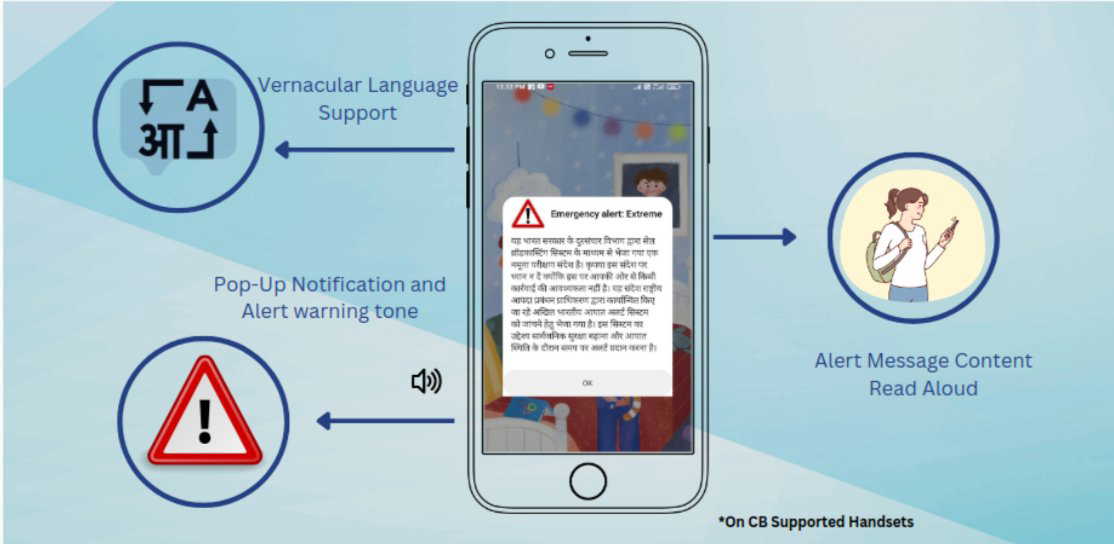
Cell Broadcast works more like a radio or TV tower. It doesn't care who's listening. It just shouts into an area. Every phone within range of a particular mobile tower catches the signal automatically. No addressing, no queuing, no congestion.
In a real emergency, mobile networks get choked because everyone calls their family at once. Cell Broadcast bypasses that entirely because it's a one-to-many broadcast, not millions of individual messages.
The National Disaster Management Authority (NDMA) is conducting a nationwide test of the indigenous Cell Broadcast Alert System (CBAS) on Saturday, May 2, 2026.
— Defence News Of INDIA (@DefenceNewsOfIN) May 1, 2026
The test will primarily cover Delhi NCR and the capital cities of all States and Union Territories. alerts will be… pic.twitter.com/V0PBSrByUT
Also Read | Supreme Court grants anticipatory bail to Pawan Khera in case linked to remarks on Assam CM’s wife
Loud, sudden, harmless: That alert is just a drill
Officials have stressed that the test messages are not meant to trigger panic or any response.
PIB said recipients may see multiple messages during the testing process, especially while the system is checked across the wider network, and that the alerts are only for validation.
One of the sample messages reads, "This is a TEST Cell Broadcast message,” while another note says that “no action is required by the public upon receipt of this message.”
DoT in collaboration with @ndmaindia and @CDOT_India is strengthening India’s mobile-based disaster alert systems.
— Greater Bengaluru Authority (@GBA_office) May 1, 2026
As a part of Integrated Alert System (SACHET), to enhance real-time alerts during emergencies, Cell Broadcast (CB) technology is being rolled out nationwide.
As… pic.twitter.com/4Ue5HCLyQC
Bengaluru gets the siren first
Local reports also noted that Bengaluru is among the cities where the alert test is being observed, with residents warned not to panic if their phones suddenly sound a siren on May 2.
NDMA had carried out a similar emergency alert simulation in Bengaluru in 2023. Once the trials are completed, the system is expected to deliver disaster warnings within seconds in actual emergencies.
Made in India tech powering the country’s fastest alerts
The backbone of the system is an indigenously built platform. NDMA has operationalized the Integrated Alert System (SACHET), developed by the Centre for Development of Telematics (C-DOT), the premier R&D center of the Department of Telecommunications.
It is based on the Common Alerting Protocol (CAP), as recommended by the International Telecommunication Union, and is currently operational across all 36 states and union territories of India.
The existing SMS component of SACHET has already proven its scale—the system has disseminated over 134 billion SMS alerts to date, in more than 19 Indian languages, during natural disasters, weather warnings, and cyclonic events. The Cell Broadcast technology is now being added to address scenarios demanding near-instant response.
Those who wish to opt out of test alerts during the trial period can do so through their device's safety and emergency settings.