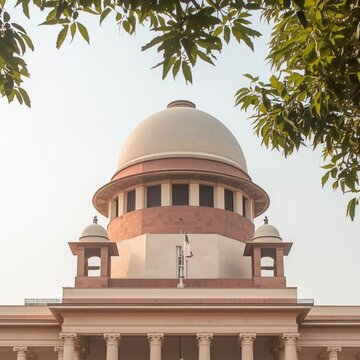
The Supreme Court (SC) on Tuesday ruled that women Short Service Commission (SSC) officers are entitled to Permanent Commission, holding that their denial was rooted in systemic discrimination within the armed forces. A bench led by Chief Justice Surya Kant said the existing evaluation process was flawed and placed women officers at a disadvantage compared to men.
Invoking its powers under Article 142 of the Constitution, the court issued wide-ranging directions to address past injustices and ensure fair opportunities going forward.
A bench headed by Chief Justice Surya Kant said, “Male SSCOs (Short Service Commission Officers) cannot expect that the Permanent Commission will remain exclusively male. The denial of Permanent Commission to women SSCOs was a result of discrimination rooted in the entrenched framework for evaluation.”
Arbitrary cap and flawed assessments questioned
The court ruled that the ceiling of 250 women officers per year for Permanent Commission is arbitrary and cannot be treated as binding. It also highlighted serious shortcomings in the assessment process, particularly the handling of Annual Confidential Reports (ACRs).
Also Read | Husband can’t avoid maintenance by quitting job, says Delhi High Court
According to the bench, ACRs of women officers were assessed casually and often with a pre-existing assumption that they would not be granted Permanent Commission.
“The ACRs for women were done with the assumption that they would never be eligible for Permanent Commission. Their ACRs affected their assessment. The criteria placed them at a disadvantage compared to their male counterparts. ACRs were never done with regard to overall comparative merit,” the bench said further.
“Women officers were not sent for career-enhancing courses or criteria appointments, which affected their career progression”, the court stated, highlighting the biases.
VIDEO | Delhi: On Supreme Court delivering a verdict for women Short Service Commission officers in the armed forces, Advocate Astha Sharma says, "The three‑judge bench of the Supreme Court delivered a historic verdict, noting a systemic flaw in the armed forces’ policies. The… pic.twitter.com/PUEoaxK5do
— Press Trust of India (@PTI_News) March 24, 2026
Relief on service and pension benefits
Addressing the consequences of such discrimination, the court directed that eligible women officers be deemed to have completed 20 years of qualifying service. This makes them entitled to a pension and all consequential benefits. The relief also extends to those who were considered by earlier Selection Boards but declared ineligible.
At the same time, the court clarified that Permanent Commission already granted through Selection Boards held in 2019, 2020 and 2021 will remain unaffected.
Also Read | Supreme Court tightens grip on adjournments: Here's what the new rules mean for lawyers and litigants
Service-specific observations
The ruling will not cover women Short Service Commissioned Officers (SSCWOs) and intervenors from the Judge Advocate General (JAG) and Army Education Corps (AEC) streams.
The court accepted the Navy’s “dynamic vacancy model” as reasonable, but pointed out that the Defence Ministry and the Navy had not disclosed selection criteria or marks. This lack of transparency, it noted, created complications, including for male officers.
In the Air Force, the court observed that officers who were not given a proper chance to be assessed for career progression cannot be denied Permanent Commission based on length of service. At the same time, it said reinstatement or fresh consideration would not be suitable from the standpoint of operational effectiveness, though this cannot be a ground to deny them their due benefits.
The court also called for a comprehensive review of evaluation processes across the armed forces to remove structural bias and ensure fairness.