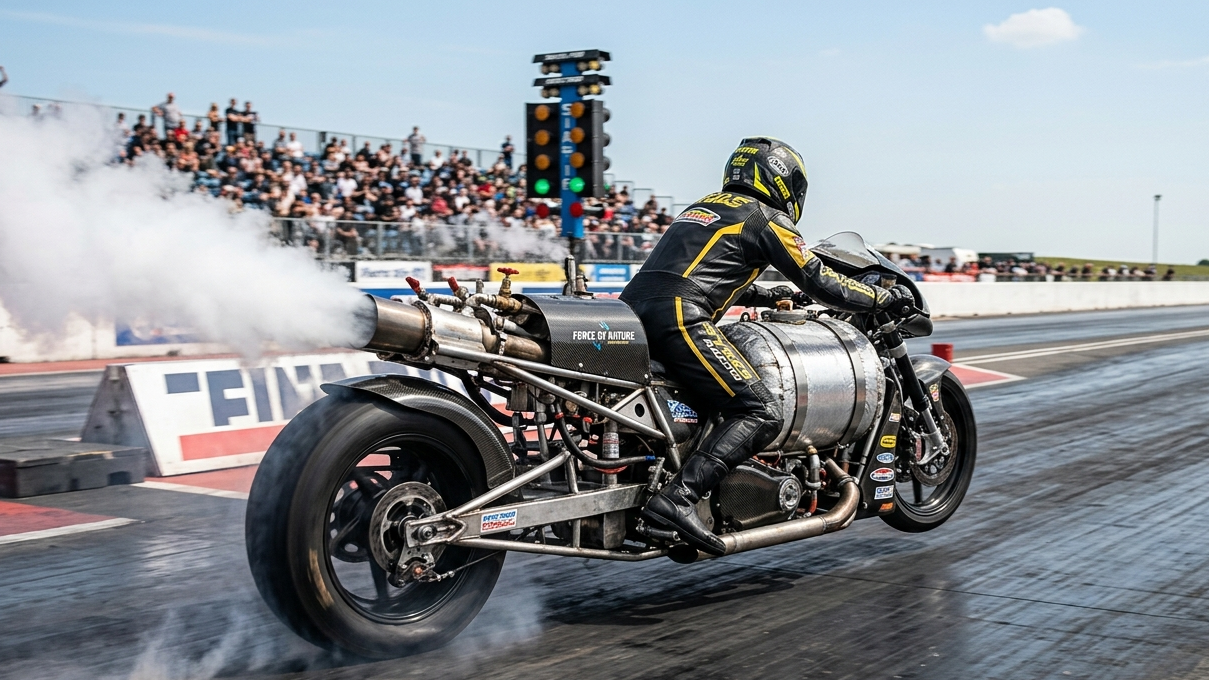
For most riders, speed is something defined by limits. Road rules, machine capability and human reflexes all combine to create a ceiling that few ever cross. But far away from conventional motorcycling, a radical machine is challenging that very idea. Built not by a major manufacturer but in a modest workshop, the Force of Nature has emerged as one of the quickest accelerating motorcycles ever created, rewriting expectations of what two wheels can do.
A backyard project with record-breaking intent
The man behind this extraordinary creation, Graham Sykes, did not come from a factory-backed racing team. Along with his wife Diane, he spent years developing the bike in North Yorkshire, refining it through multiple iterations. What began as an experimental idea evolved into a serious drag machine capable of extraordinary numbers. At events like the Festival of Power in the UK, the bike has clocked a quarter mile in just 5.503 seconds at nearly 193 mph, placing it second only to machines like Eric Teboul’s rocket-powered drag bike.
How steam becomes raw thrust
Unlike conventional motorcycles that rely on internal combustion engines, this machine uses superheated water to generate thrust. Before a run, water is heated to extreme temperatures inside a pressure vessel using an external unit. Once ready, the system releases the water through specialised nozzles.
Also Read | Six seats, longer range—Tesla Model Y L hits India market
The liquid instantly turns into steam as it exits, expanding violently and creating a powerful jet-like force. The process happens in fractions of a second, with massive volumes of water expelled rapidly, producing acceleration that feels closer to a rocket launch than a typical drag race.
Extreme performance with serious challenges
The latest version of the bike features a longer chassis and revised ergonomics to help the rider cope with intense forces, reportedly around six times the force of gravity during launch. Advanced components such as carbon bodywork and improved valve systems have made the power delivery more consistent. Yet, for all its brilliance, the machine remains highly specialised. Power delivery is essentially all or nothing, leaving no room for modulation. That makes it unsuitable for everyday use and keeps it firmly in the realm of experimental engineering.
Also Read | From the R 100 to the R 1300, BMW celebrates 50 years of the RS legacy
Despite the risks and limitations, Sykes continues to push boundaries. His next goal is even more ambitious, aiming to break into the four-second quarter-mile bracket. If achieved, it would further cement this unconventional machine as one of the most extreme motorcycles ever built.