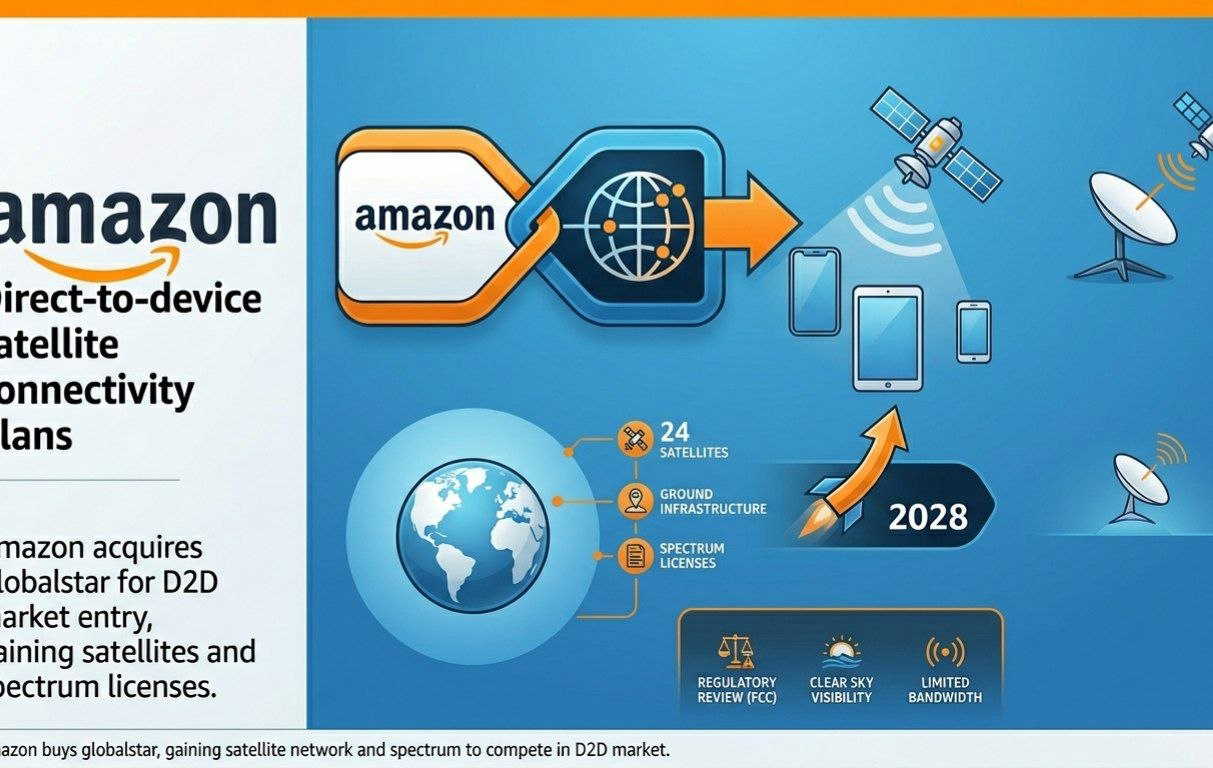
Amazon has agreed to purchase Globalstar, the satellite operator behind Apple's Emergency SOS feature, for approximately $11.57 billion. The acquisition, announced April 14, hands Amazon control of Globalstar's 24-satellite LEO network, ground infrastructure, and critically, its globally authorised spectrum licenses.
The deal accelerates Amazon's push into direct-to-device (D2D) satellite connectivity, a service the company plans to launch in 2028. Amazon's existing fleet of over 200 satellites will operate alongside Globalstar's constellation. Apple, which holds a 20% stake in Globalstar following a $1.5 billion investment in 2024, will retain access to the network under a new agreement covering Emergency SOS and off-grid messaging for iPhones and Apple Watches, as cited by The Indian Express.
How D2D satellite technology works
D2D satellite services help cover areas where building cell towers is not practical. These include remote forests, oceans, and mountainous regions. LEO satellites orbit between 160 and 2,000 kilometers above Earth. They work like ground-based cell towers. They receive signals from phones when no tower is available. Then, they relay the signal forward.
Also Read | 'We were five people and 37 minutes late': Kimono rental delay turns dramatic for Indian family in Japan
Because they are closer to Earth, they have lower latency than geostationary satellites. However, many satellites are needed to ensure continuous coverage.
A crowded and growing market
Amazon enters a competitive field. SpaceX’s Starlink already offers D2D service in the US, Canada, and Australia. It operates through carrier partnerships, including T-Mobile. In March 2026, KDDI launched what it described as the first international roaming connection via Starlink.
Also Read | Quick high, long-term damage? The truth behind the 'vodka eyeballing' craze
AST SpaceMobile is preparing its own service using spectrum borrowed from Verizon, AT&T, and Vodafone. Deloitte Global projects D2D satellite investment will reach $6-$8 billion, with end-user spending on LEO services forecast to hit $14.8 billion in 2026, according to Gartner, as reported by The Indian Express.
Regulatory and technical hurdles ahead
As per the report of the Indian Express, US Federal Communication Commission (FCC) Chairman Brendan Carr confirmed the agency will review the transaction, though he signaled a supportive posture, saying staff have been directed to move quickly on related applications. Technical limitations remain a concern. As D2D services require clear sky visibility, offer constrained bandwidth, and still depend on terrestrial gateways, leaving them vulnerable during large-scale disasters.