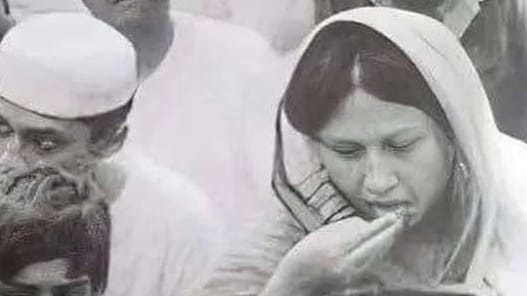
Long before she became a defining figure in Bangladesh’s national politics, Begum Khaleda Zia, who died on Tuesday at the age of 80, began life in a part of Bengal now on the Indian side of the border. Born in Jalpaiguri in undivided Bengal Province during British India in 1945, Zia’s earliest years were intertwined with the social and cultural fabric of the region that straddled the emerging states of India and Pakistan after Partition.
Khaleda Zia's roots in Bengal
Zia’s birth name was Khaleda Khanam “Putul”, and she was the third of five children in a Bengali Muslim family. Her father, Iskandar Ali Majumder, belonged to a tea-business background in Jalpaiguri, while her mother, Taiyaba Majumder, hailed from Chandbari, in present-day Uttar Dinajpur, West Bengal. The family’s roots in Bengal were cut short by the upheaval of 1947, when they moved eastward to Dinajpur in what became East Pakistan, a transition that reshaped not only geographical borders but the young Khaleda’s destiny.
“Putul” grew up amid the cultural synthesis of Bengal, a blend of language, customs and the everyday rhythms of life that echoed on both sides of the new border. She was educated at the Dinajpur Missionary School and later Dinajpur Girls’ School, reflecting a schooling that was modest yet significant in shaping her early worldview in a region marked by shared heritage.
A new life in East Pakistan
Her life took a decisive turn in 1960 when she married Ziaur Rahman, then a captain in the Pakistan Army. The move was typical of many families in the post-Partition era, navigating new identities and allegiances in the reshaped subcontinent. The couple spent several years in West Pakistan before returning to East Pakistan in 1969, as political currents leading up to Bangladesh’s independence began to swell.
It was after Bangladesh’s traumatic liberation in 1971 and the subsequent assassination of her husband in 1981 that Khaleda Zia, once a housewife with deep Bengal roots, stepped into the turbulent world of Bangladeshi politics.
Also Read | From Dhaka to global capitals, 5 key moments when Khaleda Zia’s leadership left foreign leaders taking note
What followed was a journey that saw her become Bangladesh’s first woman prime minister and one of South Asia’s most polarising leaders. Her beginnings in Jalpaiguri and the shared cultural lineage with West Bengal are reminders of an era when borders were new lines on a map but identities remained porous, woven through daily life and speech. In remembering Khaleda Zia, that Bengal connection, a part of her story often overshadowed by decades of political rivalry, offers a human context to a life lived across the shifting landscapes of modern South Asian history.