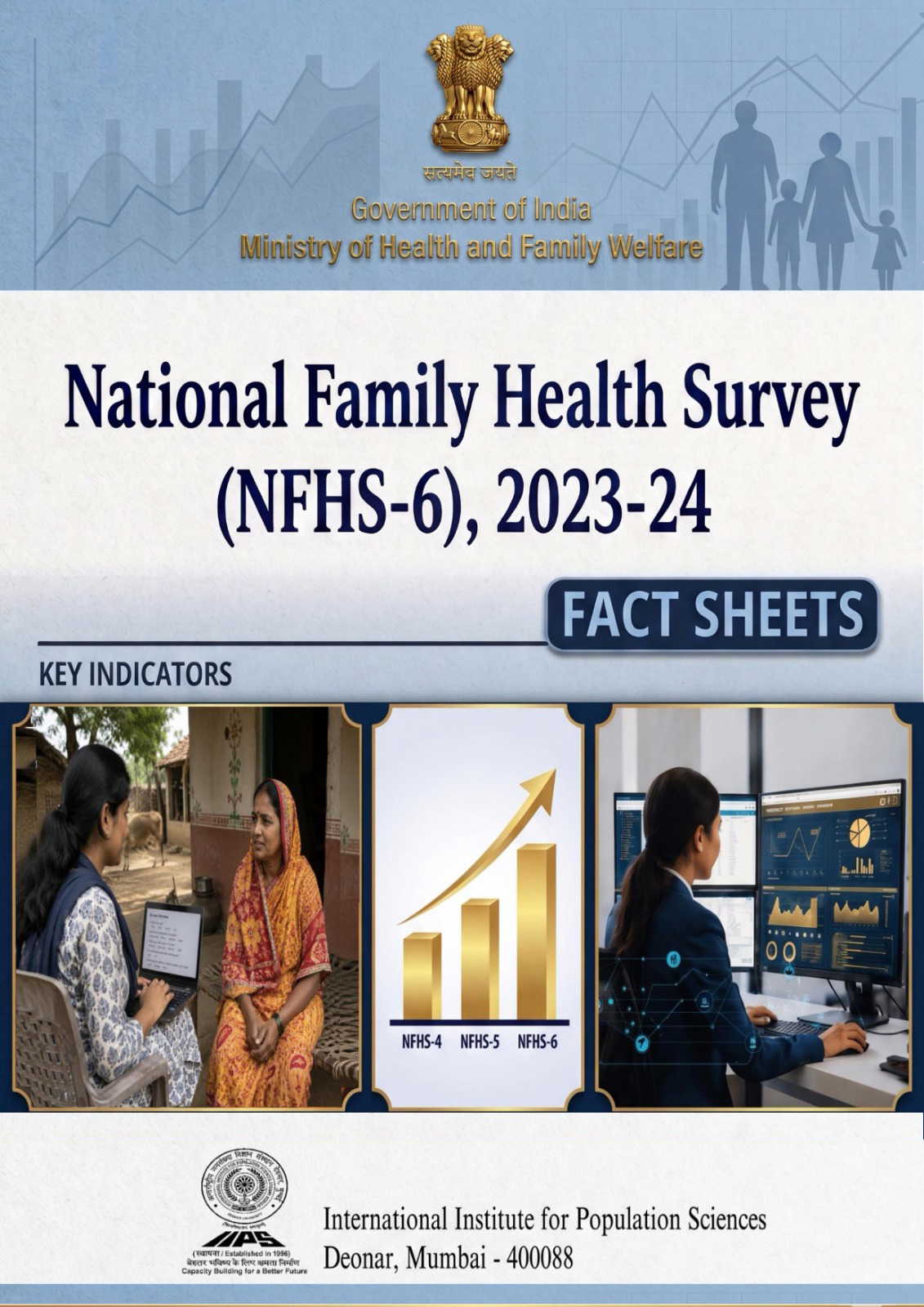
The National Family Health Survey-6 (NFHS-6) points to a mixed picture in India’s public health landscape, with stronger maternal and child health indicators on one side and a steady climb in surgical deliveries on the other.
According to the survey, institutional deliveries rose to 90.6% in 2023-24 from 88.6% in 2019-21, bringing the country closer to near-universal coverage.
At the same time, caesarean section births increased from 21.5% to 27.2%, highlighting a trend that health officials and observers have repeatedly flagged in recent years.
Also Read | Centre asks oil firms to build 30-day LPG reserves amid West Asia concerns
#HealthForAll
— Ministry of Health (@MoHFW_INDIA) May 29, 2026
Union Health Ministry Releases National Family Health Survey – 6
NFHS-6 Reflects India’s Accelerated Progress in Maternal and Child Health, Nutrition and Financial Protection
Institutional Deliveries Reach 90.6%
ANC Coverage increases from 92.6% to 95.9%
Any… pic.twitter.com/9aSHU2RYua
Rise in surgical births
The rise in surgical births was sharper in urban India than in rural areas.
NFHS-6 data show that 40.5% of deliveries in urban areas were through C-section, compared with 22.8% in rural areas. The gap was even wider across hospital types: private facilities reported C-sections in 54.1% of births, while public facilities recorded 16.9%.
The survey also showed that public health facilities saw their C-section rate rise from 14.3% earlier to 16.9% in the latest round, underlining that the increase was not limited to the private sector.
Union Health Ministry Releases National Family Health Survey – 6
— PIB India (@PIB_India) May 29, 2026
► NFHS-6 Reflects India’s Accelerated Progress in Maternal and Child Health, Nutrition and Financial Protection
► Institutional Deliveries Reach 90.6%
► ANC Coverage increases from 92.6% to 95.9%
► Any… pic.twitter.com/8cNR0S5cpE
Child health indicators improve
Child-health indicators also improved in the survey.
Severe diarrhoea among children under five declined from 0.7% in NFHS-5 to 0.5% in NFHS-6.
Over the same period, full coverage of all three doses of the rotavirus vaccine among children aged 12 to 23 months rose sharply from 36.4% to 85.4%.
Rotavirus remains one of the leading causes of severe diarrhoea and dehydration in young children, making the vaccination increase a notable public-health gain.
NFHS-6 highlights encouraging progress in strengthening immunization coverage across the country. More children are now receiving the second dose of measles vaccine and the birth dose of Hepatitis B vaccine compared to NFHS-5.
— Ministry of Health (@MoHFW_INDIA) May 29, 2026
Continued efforts towards wider vaccine access are… pic.twitter.com/ibuyETesoD
Many hands behind the progress
The Ministry of Health attributed the improvement to coordinated work under the National Health Mission, including the Universal Immunisation Programme and the STOP Diarrhoea Campaign.
Frontline workers such as ASHAs, ANMs and Anganwadi Workers have been promoting ORS, zinc supplementation, breastfeeding, handwashing, nutrition awareness and early treatment-seeking behaviour.
“These sustained awareness and outreach activities have strengthened community-level management of diarrhoea, particularly in rural and underserved regions,” the ministry said.
It also linked the trend to improved access to safe drinking water under the Jal Jeevan Mission, with rural tap-water coverage rising from 17% in 2019 to 81%, reaching 15.85 crore households and more than 5.91 lakh villages.
Also Read | AAP storms Punjab civic polls as Congress trails and BJP pockets gains
NFHS-6 reflects encouraging progress in maternal healthcare across the country.
— Ministry of Health (@MoHFW_INDIA) May 29, 2026
Improved access to antenatal care and timely postnatal support for mothers highlights the continued strengthening of healthcare services for women during pregnancy and after childbirth.
Every step… pic.twitter.com/Bx5ZsyuUVN
Encouraging gains, unfinished business
The combined effect of vaccination, sanitation, hygiene promotion, nutrition and safe drinking water was helping bring down under-five mortality, which had fallen from 45 per 1,000 live births in 2014 to 28 per 1,000 in 2024.
The NFHS-6 findings show measurable gains in child health even as the rise in C-sections leaves a separate policy challenge for the health system.