The time was May 2020. Eleven-year-old Ruby, Ruby Reynolds, was walking with her father Justin along the Somerset coast of England. The beach in that area, known as 'Blue Anchor', is famous as a 'fossil paradise'. With a little careful observation, one can spot 'unusual' pieces of stone there. When these pieces are broken, it becomes evident that nature has carefully preserved the remains of creatures that died millions of years ago within the stone. Alongside professional fossil hunters (paleontologists), many people like Justin search for fossils in that area purely as a hobby. Justin often has his daughter Ruby as a companion by his side.
Also Read | No work on Wednesdays: Sri Lanka announces 4-day week to tackle fuel shortage amid war fallout
That day, it was Ruby's eyes that caught sight of such a fossilized bone fragment that could be the envy of any fossil hunter. Not could be but has been. That minor's discovery is set to significantly change prevailing notions about prehistoric life. Because it is the fossil of the largest marine reptile found so far.
Ruby and Justin still remember quite well that day from six years ago. While walking by the sea, they spotted a bone fossil about four inches long. Later, when they sent a photograph of the object to fossil researcher Dean Lomax, the incident began to take a different turn. Lomax has long experience working with marine reptiles. So it didn't take him long to understand the matter. In Lomax's words, 'They had identified it correctly. That bone belonged to a type of marine reptile. The species name is ichthyosaur. Reptiles of that species dominated the seas during the Triassic period, that is, from 250 million years ago to 200 million years ago.'
Ichthyotitan severnensis: One of the largest marine reptiles ever discovered
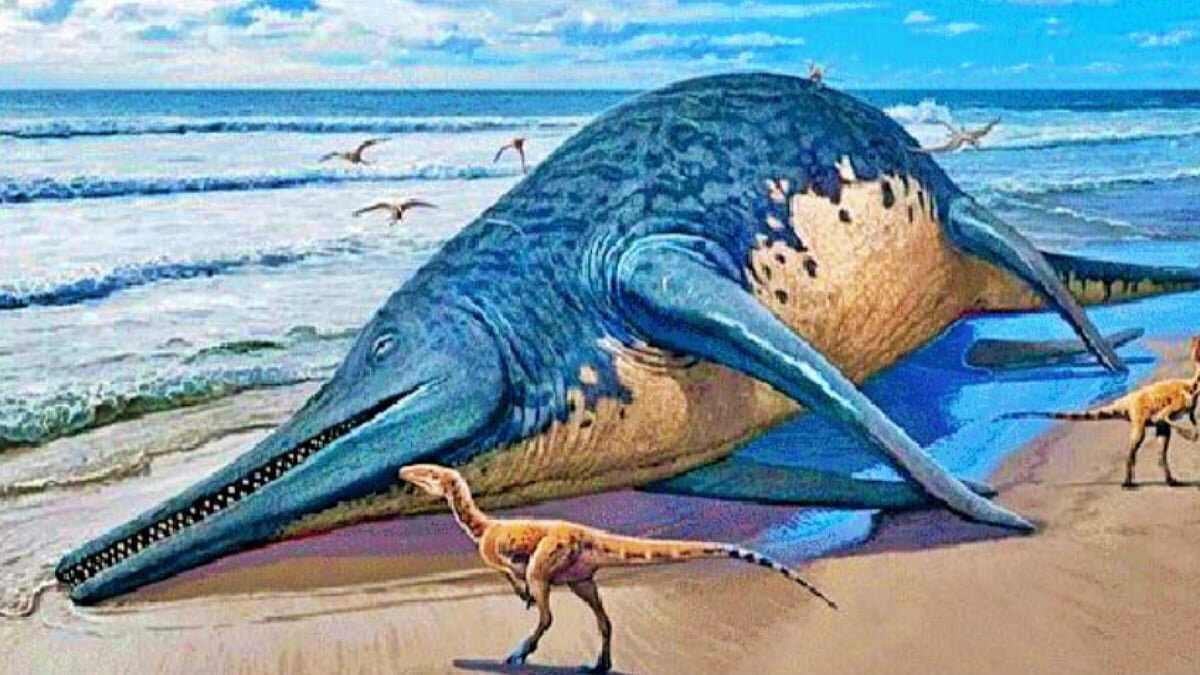
The creature whose fossil caught Ruby's attention that day in Somerset was named Ichthyotitan severnensis. Its length was approximately 82 feet which is comparable in size to today's blue whale. This discovery, which has shaken the foundations of paleontology, was confirmed in a research paper published in the renowned scientific journal 'PLOS One'. However, the chapter of Ichthyotitan severnensis doesn't stop with just Ruby's discovery.
In 2016, local collector Paul de la Salle had found a portion of a jawbone of a creature of that species in Somerset. When Ruby's fossil was compared with that earlier discovery, it became clear that they belonged to the same species. Later analysis of the jawbones showed that their size and structure were much larger and different from other common marine reptiles of that time.
According to Lomax, this new discovery reveals that the creature was 'unusual and extremely massive in size'. Its jawbone alone was more than six and a half feet long. Its skull was probably more than 10 feet long. And its paddle-like fins helped it move swiftly across the vast ocean. From these bone measurements alone, it's evident that Ichthyotitan severnensis was one of the largest creatures that ever lived in the sea.
Also Read | Watch | Kabul hospital engulfed in flames after Pakistan airstrike, 400 feared dead
Its physical structure indicates that they were accustomed to covering long distances in the open ocean and could probably rival today's blue whale in size. It is believed that Ichthyotitan severnensis survived by hunting cephalopod creatures like squid, which were abundant at that time.
Fossil researchers are optimistic that more such new fossils will be found through excavation work in the coming days, which will reveal many more new and amazing facts about this giant creature.