From a curious schoolgirl in Tehran who loved novels to a mathematician who reshaped the world of geometry, Maryam Mirzakhani’s journey was extraordinary.
Maryam Mirzakhani was an Iranian mathematician who made history in 2014 by becoming the first woman to win the Fields Medal, widely regarded as the highest honour in mathematics and often referred to as the “Nobel Prize of mathematics.” Her groundbreaking achievement brought global attention to her work and challenged long-standing gender barriers in the field.
Who was Maryam Mirzakhani?
Born and raised in Tehran, Iran, Mirzakhani did not initially dream of becoming a mathematician. As a schoolgirl, she loved reading novels and once imagined herself becoming a writer. Mathematics only began to interest her after a teacher introduced her to mathematical puzzles. Over time, she began to see mathematics not as rigid formulas but as a creative and imaginative process, similar to storytelling.
ALSO READ | Trump claims US has ‘completely decimated’ Iran, asks countries to' take care’ of Strait of Hormuz
Her talent soon became evident. As a teenager, Mirzakhani won two gold medals at the International Mathematical Olympiad, one of the world’s most challenging competitions for young mathematicians. In 1995, she even achieved a perfect score, establishing herself as one of the brightest mathematical minds of her generation.
Later, she moved to the United States for higher studies and eventually became a professor of mathematics at Stanford University, where she continued her groundbreaking research.
Historic Fields Medal and her lasting legacy
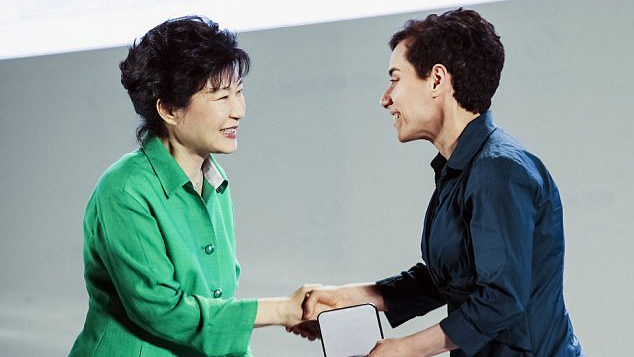
Mirzakhani achieved global recognition in 2014 at the International Congress of Mathematicians in Seoul, when she was awarded the Fields Medal. The award had been given only to men since its introduction in 1936, making her victory a historic moment for women in science.
Her research focused on geometry and dynamical systems, particularly the behaviour of curved surfaces and spaces. Though highly abstract, her work helped mathematicians better understand complex subjects such as theoretical physics, quantum mechanics and the geometry of the universe.
Mirzakhani was also known for her unusual way of solving mathematical problems. Instead of writing traditional notes, she would spread large sheets of paper across the floor and fill them with sketches and diagrams. To outsiders, these drawings looked like art, but they were actually visual representations of intricate mathematical ideas. Her daughter Anahita would often look at these drawings and say, “Mummy is painting again.”
Despite her achievements, Mirzakhani lived a quiet and private life. She was married to Czech theoretical computer scientist Jan Vondrák, and the couple had a daughter.
ALSO READ | Trump claims US has ‘completely decimated’ Iran, asks countries to' take care’ of Strait of Hormuz
What happened to Maryam Mirzakhani?
Tragically, not long after receiving the Fields Medal, Mirzakhani was diagnosed with breast cancer. She continued her research while battling the illness, but passed away in 2017 at the age of 40. Her death sparked an emotional response in Iran, with newspapers publishing her photograph without a headscarf on their front pages—breaking a long-standing media convention.
Today, Maryam Mirzakhani remains an inspiration to students and mathematicians around the world. Her life showed that curiosity, creativity and perseverance can shape even the most complex fields of knowledge.