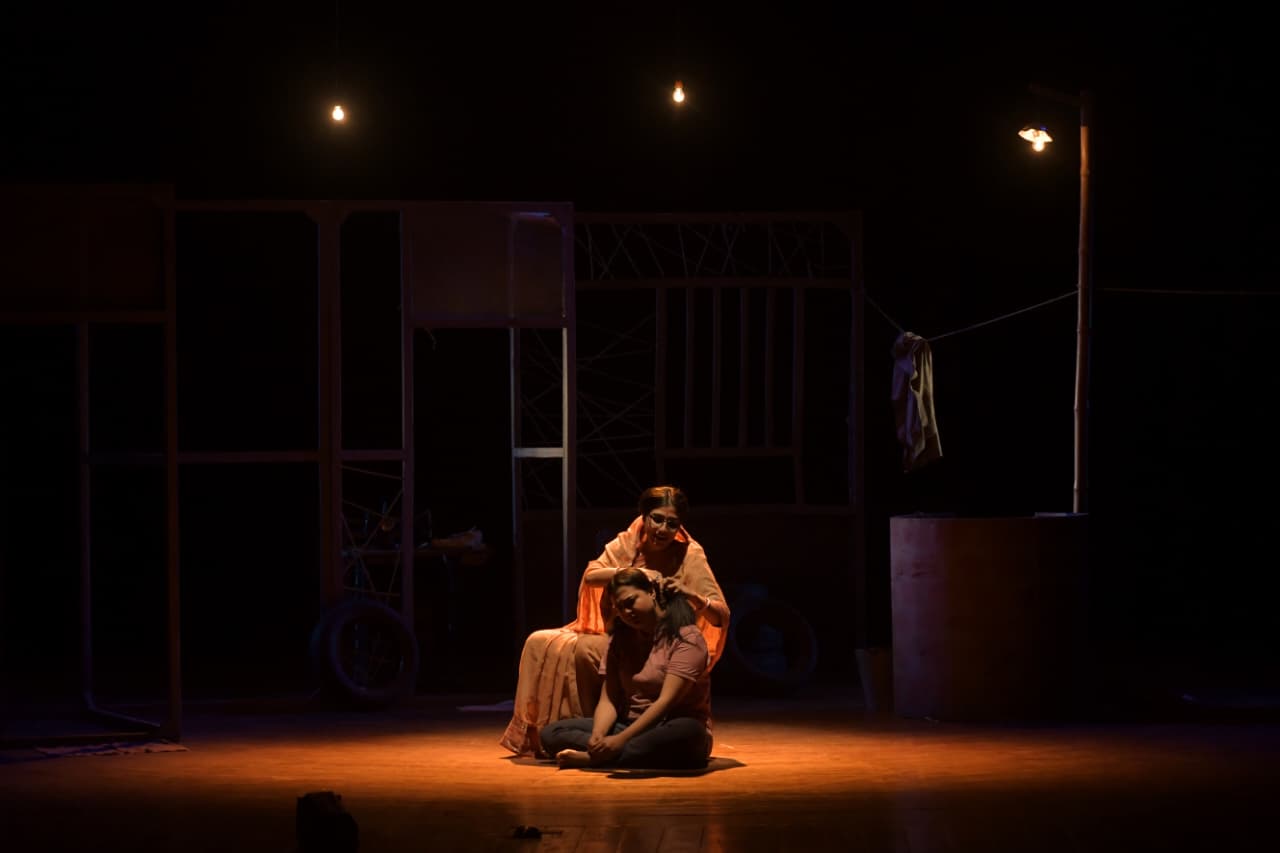
A cramped kitchen, a soot-stained electric bulb that fails to push back the darkness fully. Two tiny rooms, a small courtyard with a crumbling well, its plaster peeling away. The setting is simple, almost too simple, the everyday life of a lower-middle-class household laid bare. Their routine moves in straight lines, uneventful and predictable.
And yet, from within this very ordinariness, emerge lives that suddenly break away from the expected. Like a river that bends without warning, crashing into one bank before carving out a new course, an unforeseen moment jolts these lives out of their monotony. When that jolt comes, when the routine crumples under its weight, life begins to demand accountability. Like the river, one must then choose a direction.
A timeless play that continues to resonate
Chandan Sen’s Dayabaddha is built on such a moment.
This widely staged production by the Sayak group needs little retelling. Recently, the group announced that they would no longer stage the play. Since its inception in 1991, it has been performed 706 times. Time, after all, flows like a river. Though rooted in the 1980s, the play feels timeless, its themes tested and refined by time itself.
At its core, it is a story of relationships and their making and unmaking. It is this emotional terrain that Naihati Bratyajan brings back to the stage. By now, the group needs no introduction among theatre lovers; their productions have consistently left an impression.
Also Read | Tollywood–music industry mourns two losses within a short span, bound by ONE timeless song
Partha Bhowmick anchors the narrative with depth
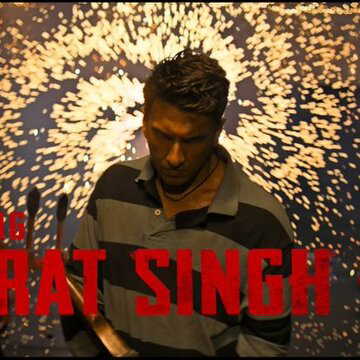
Partha Bhowmick can easily be called the driving force of this ensemble. A Member of Parliament from Barrackpore, he is as present in political rallies as he is on screen in cameo roles. Yet, on stage, he transforms completely, most notably into Gagan, a drunken truck driver.
It is not an easy role. Gagan is layered with rage, hurt, greed and desire, and Partha navigates each shade with striking precision, even under dim lighting.
The modest house described at the beginning belongs to Gagan.
A family story layered with tension and truth
The play is compact, with only a handful of characters. Gagan lives in a colony with his wife Sita and their college-going daughter Jhinee. Even his truck helper is practically part of the family. Gagan’s work takes him to places like Siliguri and Siuri, but when he returns home, he appears to be a responsible father. A responsible husband remains a question for the audience.
Because once night falls, this grounded man turns into a reckless drunk.
Sita, on the other hand, is a strong-willed woman who wants everything under control. She is determined to marry off her daughter quickly. She does not hesitate to pay a bribe of one lakh rupees to secure a job for Jhinee’s supposed lover, hoping it will hasten the marriage. She wants her daughter out of the house, away from Gagan. But why
A revelation that reshapes everything
The answer arrives like a blow. In a moment of intense conflict, Sita reveals that Jhinee is not Gagan’s daughter and that Gagan is not her husband.
Also Read | Bengali show 'Kuheli' set to release this May on Hoichoi
The audience then learns of her past. At a difficult turning point in life, she had been forced to leave her doctor husband’s home with her daughter. She found shelter with Gagan, building a life under the same roof. But was it ever truly a marriage? That question lingers, unanswered, for the audience to grapple with.
Performances that stay with you
Partha anchors the play as Gagan. Known for his articulate presence in television debates and political forums, he brings an unexpected ease to the stage. Watching him perform, one might even feel that his political appearances are the real performances.
As Gagan, he disappears entirely into the character. His portrayal of a helpless father, especially in the aftermath of Sita’s revelation, lingers long after the curtain falls.
Debjani, as Sita, is equally compelling. She reinvents herself with each performance, revealing her depth as an actor. Debolina Singh, as Jhinee, is convincing and grounded. The supporting cast, all regular members of Partha’s team, deliver with consistency and care.
ALSO READ| Enchanting Pabong: Inside North Bengal’s hidden treasure
Direction and lighting elevate the experience
Director Aritra Bandyopadhyay deserves credit for consciously avoiding melodrama, even when the script offers scope for it. This restraint strengthens the emotional impact of the narrative.
Special mention must be made of Soumen Chakraborty’s lighting. A soft, melancholic glow washes over the stage throughout, setting the emotional tone from the very beginning. The interplay of light and shadow becomes almost like the river itself, revealing each turn, each fracture and each quiet transformation.