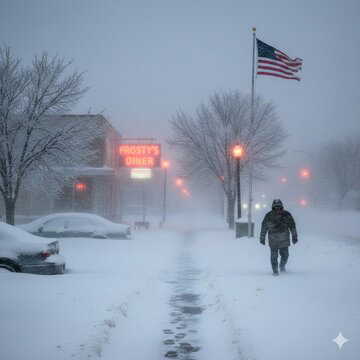
A massive snowstorm swept across the northeastern United States on Monday, stretching from Maryland to Maine and forcing millions indoors. Strong winds, blizzard warnings, transport shutdowns, school closures and power cuts brought normal life to a standstill.
Meteorologists described it as the strongest storm in a decade. In some parts of the metropolitan Northeast, more than 2 feet (60 cm) of snow fell, breaking long-standing accumulation records. The impact was so severe that even the United Nations postponed a Security Council meeting. Several states and cities declared emergencies, and New York City announced its first traditional “snow day” in six years.
ALSO READ | PM Modi to return to Israel after nine years, set to address the Knesset and hold key bilateral talks
The National Weather Service called it a “classic bomb cyclone/nor’easter off the Northeast coast.” A bomb cyclone occurs when a storm’s pressure drops rapidly within 24 hours, typically in fall or winter when cold Arctic air clashes with warmer air. Forecasters said the storm hit the “Goldilocks situation”, temperatures were just right for heavy, wet snow. Owen Shieh from the Weather Prediction Centre in Maryland explained that if it had been warmer, the precipitation would not have fallen as snow, and if colder, there wouldn’t have been enough moisture to fuel such heavy snowfall.
Flight cancellations and power outages
Air travel was heavily disrupted. More than 5,600 flights in and out of the US were cancelled on Monday, with another 2,000 Tuesday flights grounded, according to FlightAware. Nearly 2,500 flights were delayed. Most cancellations were reported at airports in New York, New Jersey and Boston. Rhode Island’s T.F. Green International Airport temporarily halted operations after receiving 32.8 inches of snow, breaking a record set in 1978.
Over 450,000 utility customers nationwide were without power on Monday evening, as strong winds and heavy snow damaged trees and power lines. The highest wind gust of 83 mph (133 kph) was recorded in Nantucket, with hurricane-force gusts across Cape Cod.
ALSO READ | Who is Rob Jetten? All you need to know about the Netherlands' youngest and first openly gay Prime Minister
Transit, schools and daily life disrupted
Public transport systems struggled. While most New York subway lines resumed service by Monday evening, Staten Island rail service remained suspended. Commuter rail services were expected to resume limited operations before Tuesday morning, though delays were likely. Bus commuters were warned to expect long waits.
New York City and Boston cancelled public school classes for Monday, while Philadelphia shifted to online learning. Several districts on Long Island and in the New York suburbs cancelled Tuesday classes as well. Broadway shows were called off Sunday evening, and landmarks such as the Museum of Modern Art and Arlington National Cemetery were closed.
In Lower Manhattan, snow shovelers outnumbered office commuters. Central Park recorded 19 inches of snow, while Warwick, Rhode Island, saw over 3 feet - the highest total in the country so far.
Even as the storm began moving north and easing in some areas, the National Weather Service warned that another system could bring more snow later in the week.