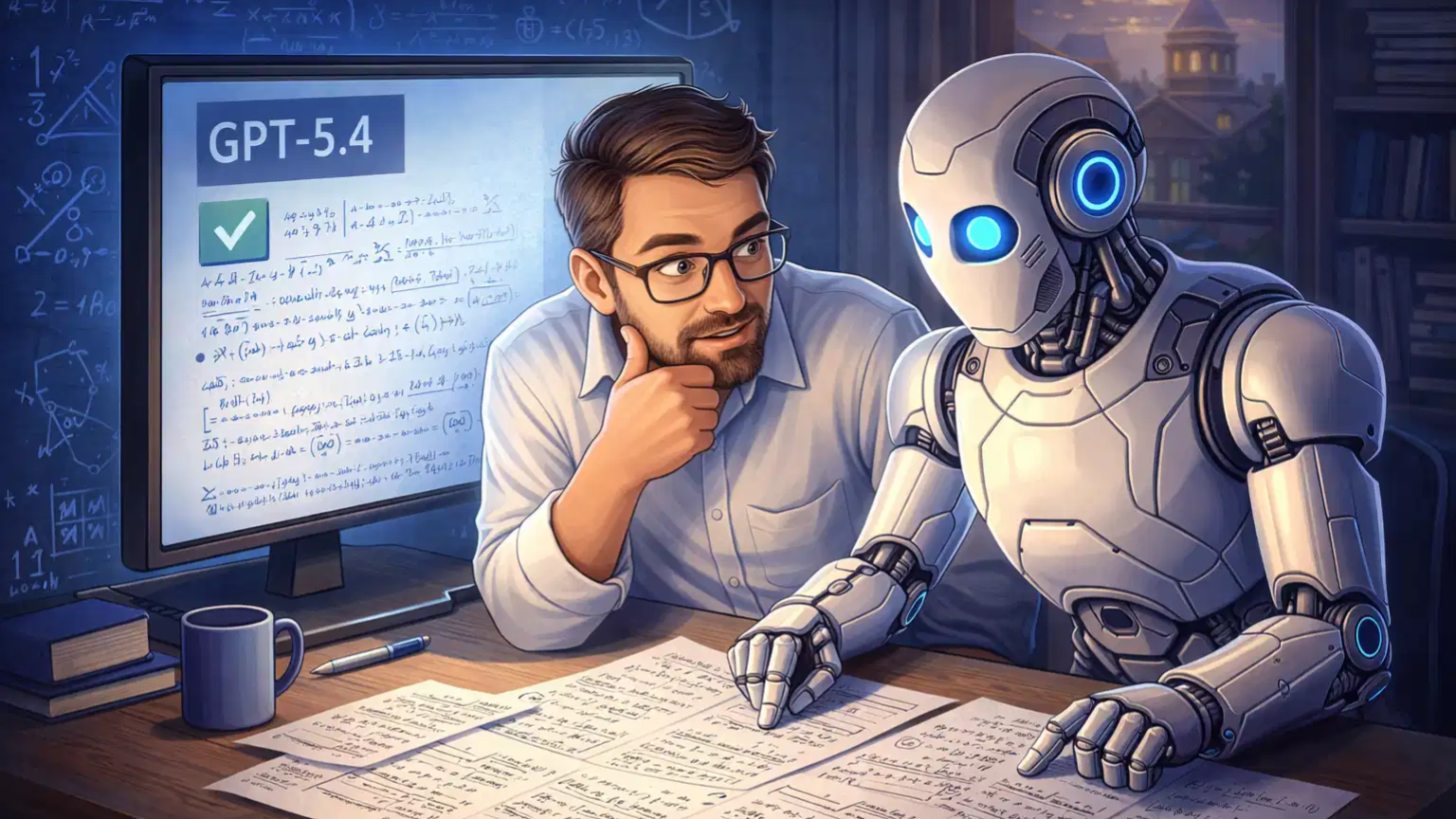
A Polish mathematician who previously saw artificial intelligence as nothing more than a very powerful calculator said he was surprised after a model of artificial intelligence solved a math problem he designed after nearly two decades.
The math problem was designed by Bartosz Naskrecki, a mathematician at Adam Mickiewicz University in Poznań, Poland, as part of a set of extremely challenging math problems called FrontierMath.
Also Read | Instagram to remove message encryption from May 8: Here's what it means for users
The math problem was recently attempted by a model of artificial intelligence called GPT-5.4 and succeeded in producing a correct solution in one out of eleven tries.
A problem designed to test the limits of AI
According to Naskrecki, the problem took nearly 20 years to refine and required a detailed solution spanning about 13 pages of mathematical reasoning.
The FrontierMath benchmark includes problems from advanced areas such as number theory, topology, combinatorics and algebraic geometry, fields that often demand creativity and deep conceptual thinking.
Naskrecki previously argued that such problems were beyond the reach of artificial intelligence. In earlier remarks about AI systems, he had described them as “a very advanced calculator,” suggesting they lacked the conceptual understanding required for genuine mathematical discovery.
However, recent experiments with newer models produced an unexpected outcome. During testing, GPT-5.4 attempted the problem multiple times. Although most attempts failed, one response correctly solved the challenge.
Researcher reacts to unexpected result
After reviewing the output, Naskrecki shared his reaction on the social platform X, saying he was impressed by the quality of the solution.
“It finally happened… I am deeply impressed. The solution is very nice, clean, and feels almost human,” he wrote.
It finally happened-my personal move 37 or more. I am deeply impressed. The solution is very nice, clean, and feels almost human. While testing new models in the last few weeks, I felt this coming, but it's an eerie feeling to see an algorithm solve a task one has curated for https://t.co/Enwz7dPYkL
— Bartosz NaskrÄcki (@nasqret) March 5, 2026
The mathematician described it as an exciting but slightly unnerving experience, saying it was unusual for an algorithm to crack a problem that had taken years of design to figure out.
Also Read | Want a promotion at Accenture? CEO Julie Sweet says mastering AI is now essential
The mathematician also said that it is possible for tools of this kind to help researchers, rather than replacing them, as it can help mathematicians think through ideas more speedily.
Experts say that it takes many attempts and human verification for an AI system to tackle complex mathematical problems, but the result is an illustration of the tremendous progress of AI models in solving complex reasoning problems, which were previously considered the exclusive domain of humans.