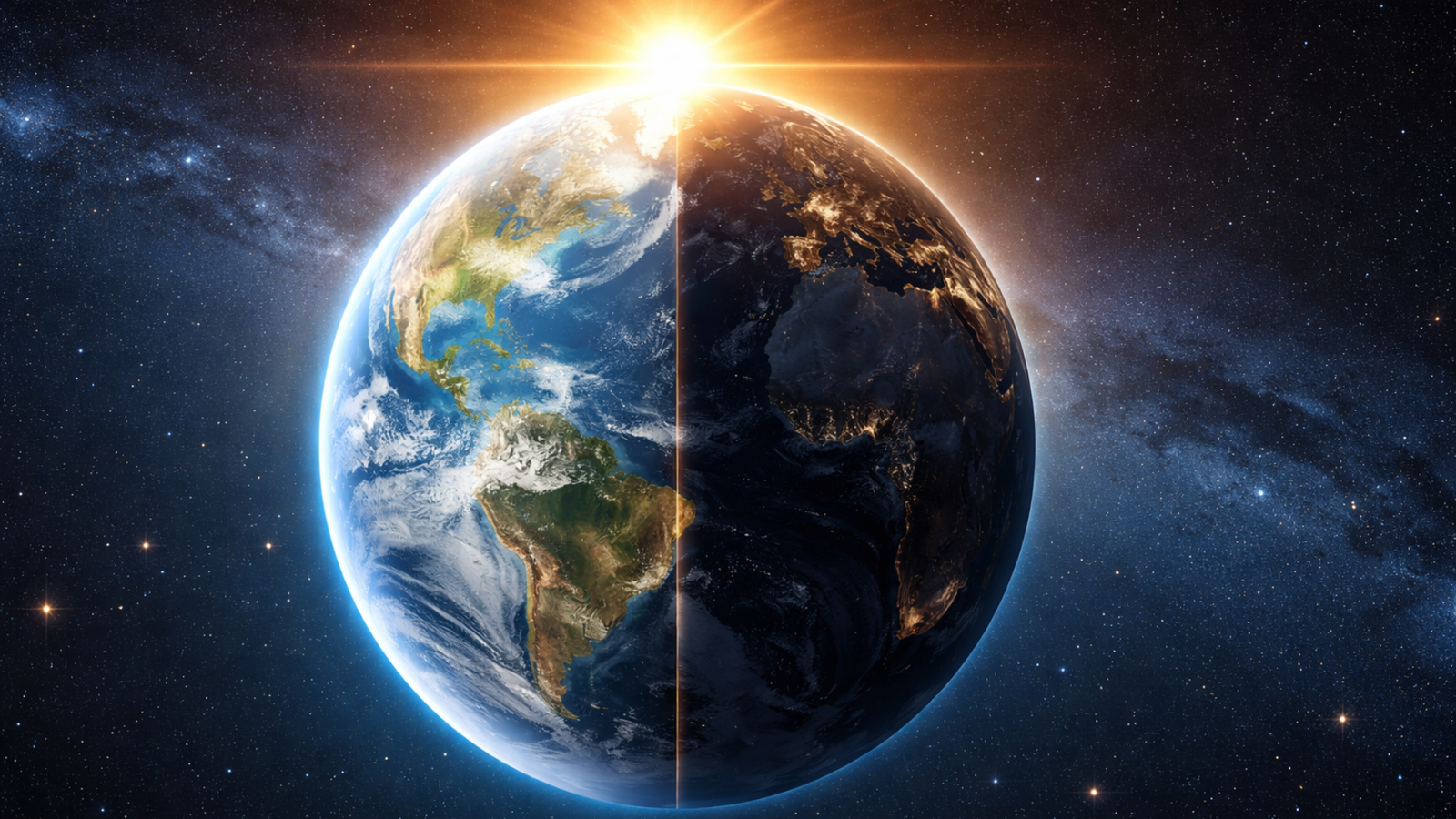
The March equinox, set to occur on March 20, 2026, is one of the most important astronomical occurrences in the calendar of the year. It is a moment when the Earth is in a state of equilibrium in the distribution of Sun rays in the hemispheres.
What is the March equinox?
The March equinox occurs when the axis of the Earth is neither tilted towards nor away from the Sun. At this moment, the Sun is directly over the equator of the Earth. This ensures that the Northern and Southern Hemispheres of the Earth are equally exposed to the Sun.
This also means that the line separating day and night is straight from the North Pole to the South Pole, which ensures a uniform distribution of light on the Earth’s surface.
Also Read | What is Navroz? All about the Persian New Year and the 7 Haft-Seen traditions
What happens on Earth during the equinox?
As the equinox occurs, most places on Earth experience nearly 12 hours of daylight and 12 hours of darkness. This is not entirely true, however, as the bending of light in the atmosphere and the fact that the Sun is a disc, not a point, mean that daylight hours are slightly longer than dark hours.
Another notable phenomenon is the position of the Sun in the sky. On this day, it crosses the equator, moving from the southern half of the sky into the northern half of the sky.
Unlike the case with eclipses and meteor showers, the equinox does not occur in specific areas. It is a global phenomenon and can be observed anywhere on the face of the Earth.
Also Read | Why does Arabia call Eid first when India should see the moon earlier?
Sun rises due east, sets due west
The Sun’s path is also one of the characteristics of the equinox. It should be noted that on this day, the Sun rises almost due east and sets almost due west. This phenomenon only occurs a few times a year, and the most precise time this phenomenon occurs is during the equinox.
The March equinox in 2026 will occur at 09:46 a.m. EST, when the Sun will be directly above the equator, marking the beginning of a new season for both hemispheres.