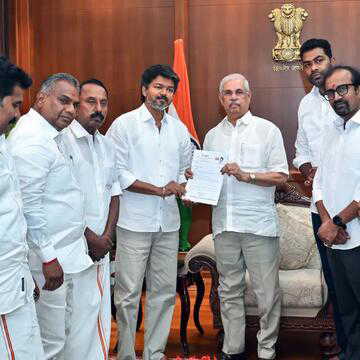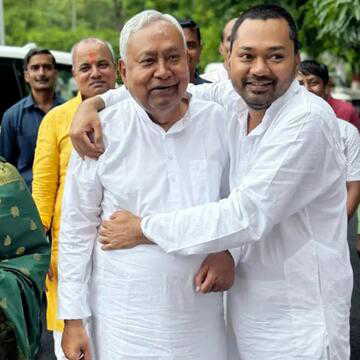
The term “floor test” has resurfaced sharply after the post poll churn in Tamil Nadu and West Bengal.
In Tamil Nadu, TVK chief Vijay met Governor Rajendra Vishwanath Arlekar and sought to stake claim to form the government, but reporting from the state said the governor wanted to be certain the party had the numbers before any swearing in.
In West Bengal, the political and constitutional debate intensified after Mamata Banerjee said she would not resign, even as the current Assembly’s term ended and questions rose over who would run the state until a new government takes charge.
IMPORTANT: TN governor Rajendra Arlekar has in an official Lok Bhavan release told Vijay and TVK that requisite support has not been established for him to be sworn in. Amidst contrasting precedents, one thing is CLEAR: majorities cannot be decided in Lok Bhavan BUT on floor of… pic.twitter.com/Ys97P82xs9
— Rajdeep Sardesai (@sardesairajdeep) May 7, 2026
What is a floor test?
A floor test is, in essence, a test of majority support in the Legislative Assembly.
The Constitution makes the Council of Ministers collectively responsible to the Assembly, while the Governor appoints the chief minister and has the power to summon the House, prorogue it and dissolve the Assembly.
Article 163 says the Governor is ordinarily to act on the aid and advice of the Council of Ministers, except where the Constitution requires discretion.
Read together, these provisions explain why floor tests are invoked when there is doubt over whether a ministry still commands the confidence of the House.
The Supreme Court has also held that such a call must rest on objective material and cannot be used to destabilise an elected government.
Also Read | Vijay meets Tamil Nadu Governor again amid race to form government
DK Shivakumar Accuses Tamilnadu Governor of Undermining Democracy, Says ‘Test on the Floor, Not in Lok Bhavan’
— Yasir Mushtaq (@path2shah) May 7, 2026
Bengaluru
Karnataka Deputy Chief Minister D.K. Shivakumar has sharply criticized the #Governor of #TamilNadu, calling recent delays in government formation “unfair”… pic.twitter.com/H8dALEgtZ0
The Assembly floor is where claims get counted
In practice, a floor test becomes relevant in two common situations. Either when a government’s majority is questioned, or when more than one claimant says it has the numbers to form a ministry.
If the Assembly is in session, the Speaker can move the process; if it is not in session, the Governor can summon the House.
In a hung House, a composite floor test may be used to determine which side has the support of members present and voting. The procedure is meant to settle the question in the open, on the Assembly floor, rather than through press statements, rival claims or behind-the-scenes arithmetic.
बंगाल का सबसे बड़ा Constitutional Paradox🔥
— Anand Sharma (@anandsh04294243) May 7, 2026
ममता बनर्जी बोलीं “इस्तीफा नहीं दूंगी" वोट चोरी हुआ
BJP के पास 207 सीटें TMC सिर्फ 80
विधानसभा का 5 साल का कार्यकाल 7 मई 2026 को मध्यरात्रि में खत्म हो गया (Article 172)
अब सवाल ये है कि 👇
》विधानसभा तो dissolve हो गई… तो Floor Test… pic.twitter.com/jiKjSyiCM6
Why an old constitutional term is suddenly everywhere?
The current developments in both of these states is why the phrase has returned to circulation now.
In Tamil Nadu, the immediate issue is whether the claimant to government can show a clear majority before taking office.
In West Bengal, the question is whether constitutional officeholders can continue to function once the Assembly term ends and the new House is not yet in place.
For now, the debate is less about the term itself than the political pressure that comes with it.
Floor tests are no longer an abstract civics lesson.