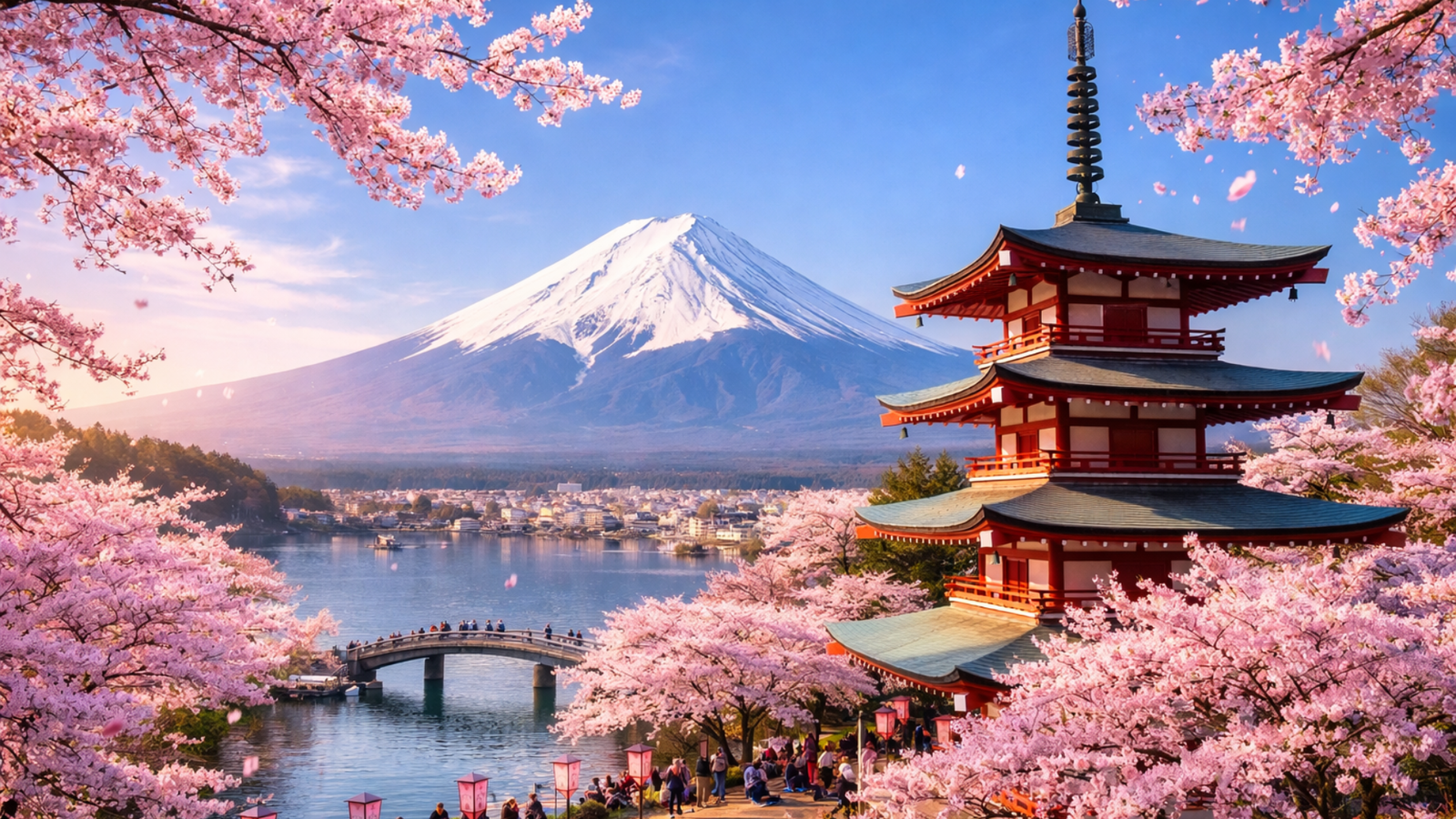
Cherry blossom season in Japan is known for its light, festive mood. Families gather under blooming trees, friends meet for evening hanami, and parks fill with people celebrating the brief arrival of spring. But behind the scenes, the task of predicting when those blossoms will appear carries immense pressure.
As per a report by the Business Times, for Hiroki Ito, a data scientist and meteorologist in Osaka, Japan, at the Japan Meteorological Corporation, spring has always been a time of tension. The stakes are high because Japan's cherry blossoms produce over $9 billion in tourism and related revenues each year, and airlines, hotels, restaurants, and millions of citizens depend on the precise timing of the blossoms.
“It’s a lot of pressure,” Ito said, reflecting on more than a decade of forecasting work. “I’m a little frightened of spring. I can’t fully enjoy it”, Business Times quoted Ito as saying further.
How AI is changing the forecast
To improve accuracy, experts are increasingly relying on artificial intelligence. Today, decades of temperature data are being analysed with the help of AI technology, and detailed maps and bloom indicators are being produced for over 1,000 locations in Japan, where the flowering times differ considerably.
Also Read | Why is April 1 celebrated as April Fool's Day? Know its history, origin and meaning
This year, the blossoming forecast is being done in a much more interactive way. Scientists are using images contributed by people and running them through AI technology to monitor the buds. These buds start to develop in the summer, remain dormant in the winter, and start to bloom two to four weeks after turning green in the spring.
At Weathernews in Chiba, scientists are using AI technology to analyse thousands of images contributed by people. Over the weekend alone, the images were being processed into seven stages of blossoming, with over 8,000 images being analysed.
From past errors to greater precision
However, forecasting is not always accurate. In 2007, the Japan Meteorological Agency was forced to publicly apologise after a computer glitch meant that predictions were out by up to nine days in some areas.
The use of AI technology has helped improve not only the timing but also the accuracy of the forecasts. The initial predictions are being made available as early as December, before the actual season even begins. The predictions for Tokyo this year were accurate by a day or two.
Also Read | Are Indians now more attached to their living rooms? New study reveals astonishing data
A tradition rooted in history
The cultural importance of cherry blossoms runs deep. The tradition of hanami dates back to the ninth century, when Emperor Saga encouraged people to admire the flowers and compose poetry. The blossoms, which fall within a week, are often seen as a symbol of life’s fleeting nature.
The bloom travels across Japan in a wave. It begins in mid-March in southern regions like Shikoku and Kyushu, moves through central Honshu, and reaches Hokkaido by early May. This year, Tokyo reached full bloom on March 28.
Despite advances in AI, human observation remains essential. Experts still inspect trees in person, including at long-monitored sites such as Yasukuni Shrine in Tokyo, where the Somei Yoshino variety is closely studied.
While AI is making the process more efficient, forecasters like Ito continue to monitor results carefully. Confidence in the technology is growing, but for now, the human touch remains part of the equation.